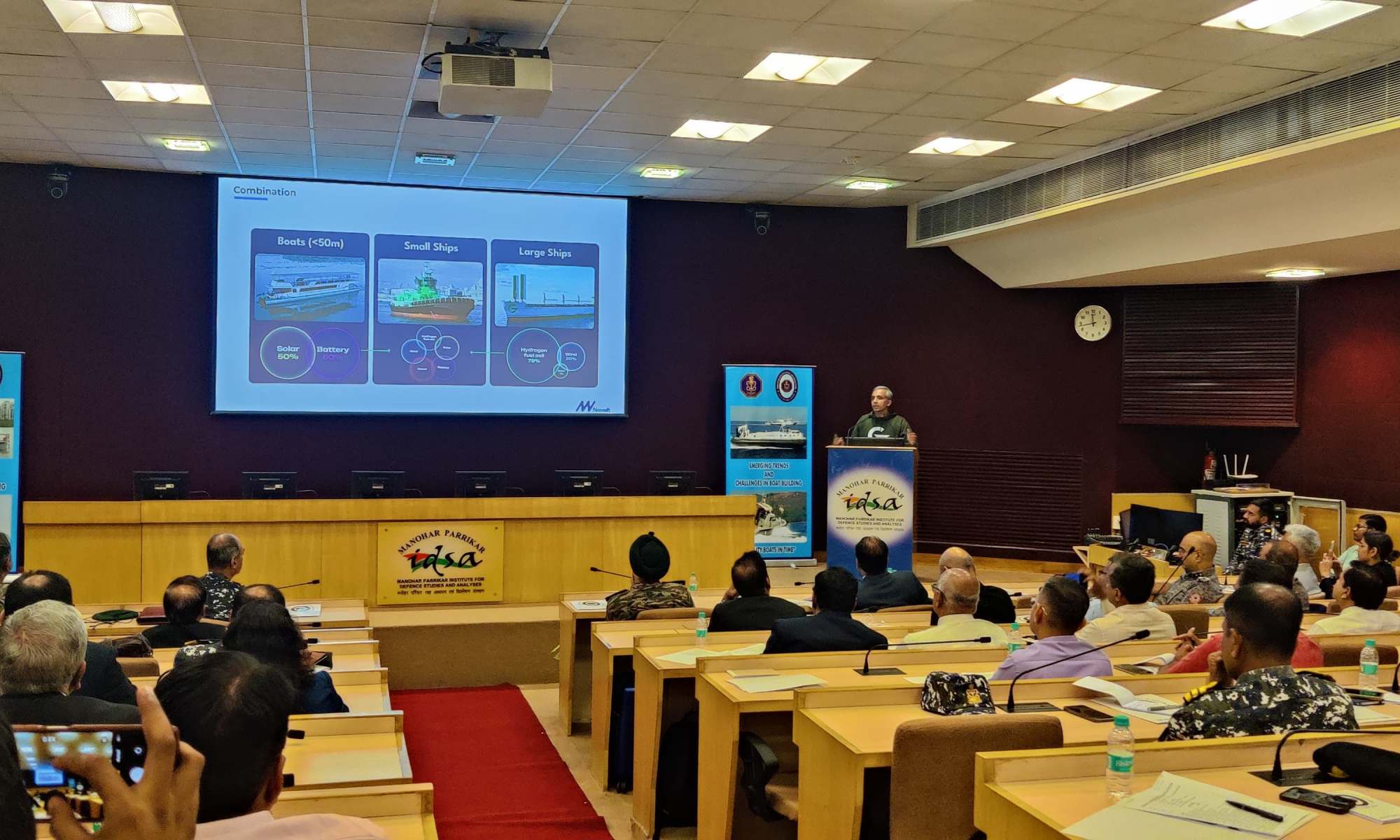

An honour to present along with the leading boatyards and equipment suppliers at Naval Headquarters in the seminar titled, “Emerging Trends and Challenges in Indian Boat Building”. It was a well attended session and the top decision makers from all the defence units were present. I talked about the various technology choices in defence vessels after citing some of our experience (26 solar electric vessels and 36 under construction) and laying out the process of taking decision. For the benefit of those who could not make it, the presentation file can be downloaded.
During the session I highlighted one of the issues faced by MSME boatyards while doing projects with defence units and PSUs namely “working capital management due to skewed payment terms”. The chair promised to look in to this matter based on the practices followed by some state government tenders where there are stage payments without bank guarantees.
Some of the key points in my talk:
- Navalt has 26 solar electric boats in operation and 36 under construction including export to Canada, Israel and Maldives.
- Four milestones explained – Aditya – India’s first solar ferry, Barracuda – India’s fastest electric boat, Srav – India’s first solar fishing boat and Indra – India’s largest solar boat
- Five sources of energy in a vessel – battery that stores grid energy, solar, wind, green fuel that can convert energy using fuel cell or engines, fossil fuel driven engines.
- Discussed Drona, the 12 m electric boat that is under construction for Navy under the IDEX scheme.
- Discussed how retrofit of fast patrol craft of Navy can save 56 crore in a year (80 crafts) with a total investment of 80 crore. The addition of 40 kWh battery and 18 kW pods can ensure the vessel can run in zero emission mode and save 60,000 litres in each craft annually. The ROI is under two years since the current boats run in slow speed at extremely low efficiency using water jets and large engines.
- Financial analysis starts with understanding cost of energy – both auxiliary and propulsion energy from each of the five source of energy. The spread between battery and fossil fuel shows that conversion of auxiliary energy need to electric sources like battery and solar must be undertaken first before propulsion since the spread in OPEX savings is much higher. Read more.
- The spread in the cost of grid and cost of fuel as well as the ratio of these costs determine the pace in electrification without other interventions. The higher the spread and ratio the faster it can be.
- For a type of vessel with multiple speed and range combination it is clear that always solar electric is cheaper (TCO-NPV) than electric. Hence, once electric, solar is recommended.
- Between the safe chemistry of LFP and LTO, for lower speed and range combination (for a 100 pax ferry it is 12 knots and 150 km) it is cheaper to go for LFP and for higher speed and range combination it is cheaper to go for LTO. The wrong choice made by Kochi Metro and recent West Bengal project where for lower speed and range LTO choice was made was highlighted. Read more.
- H2 becomes economic choice at higher speed and range combination as well as when the cost of hydrogen also is lower.
- At higher speeds and range the diesel electric hybrid also emerges as strong choice and within that parallel is cheaper than series.
Overall it was a great event and I hope more such events happen in the future.
 Sandith Thandasherry