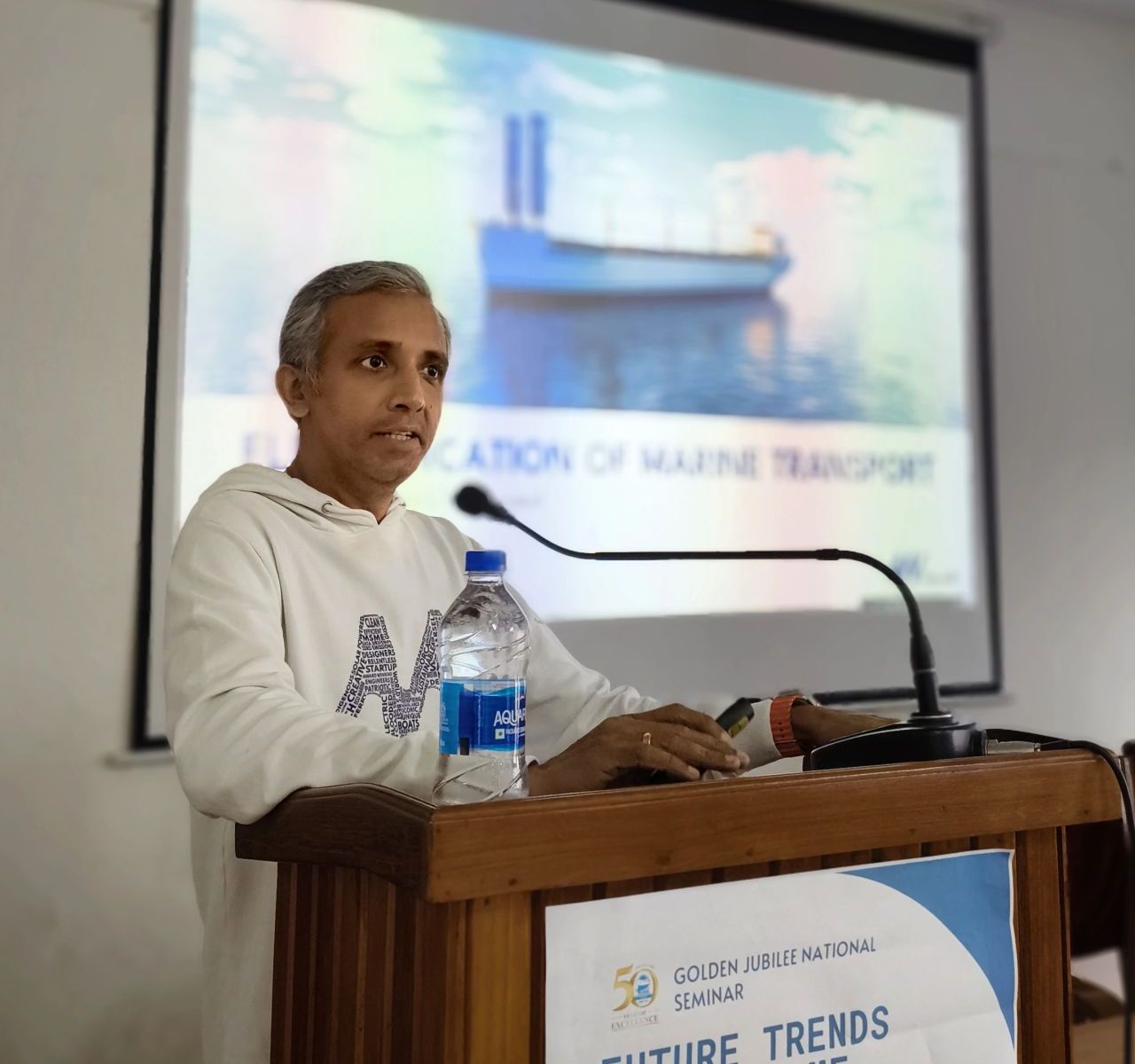


As part of the Golden Jubilee Celebrations of CUSAT, the Department organized a technical seminar on marine technologies and innovations. I had the privilege of speaking on the topic of electrification of marine transport. Below is a summary of my talk:
The Inevitable Shift to Green Technologies
The transition to green technologies in marine transport is not a matter of if but when. The purpose of the session was to outline a framework for addressing this critical question.
Key Insights from the Talk
1. Energy Sources and Cost Computation
Understanding the five primary sources of energy in a vessel and computing their associated costs can provide valuable insights for operational expense (OPEX) decisions.
- High fuel costs combined with low grid electricity costs will naturally encourage electrification without government intervention. Currently, India ranks 41st globally in this regard.
2. Prioritizing Auxiliary Energy Conversion
The potential savings from electrification are greater in auxiliary energy compared to propulsion energy. Therefore:
- Auxiliary systems should be prioritized for electrification and solar integration.
- If feasible, both auxiliary and propulsion systems can be electrified simultaneously.
3. Targeting Fuel Cell Usage
Fuel cells should be initially employed to address auxiliary energy needs before transitioning to propulsion energy systems.
4. Solar Energy and Its Role
Solar energy can drastically reduce OPEX for slow-speed vessels or vessels where solar contribution is significant. For instance:
- In a 6-knot ferry carrying 75 passengers, solar energy can contribute up to 67% of the energy requirement.
However, fully solar-electric systems may not be viable for:
- High-speed vessels
- Long-range operations
In such cases, hybrid solutions become an effective alternative.
5. Hybrid Systems: Series vs. Parallel
- Parallel hybrids generally have lower OPEX and CAPEX compared to series hybrids and are therefore the more economical choice when feasible.
Economic Analysis: The Total Cost of Ownership
To evaluate the most economical solution, it is crucial to compute both:
- Capital Expenditure (CAPEX)
- Operational Expenditure (OPEX)
The Total Cost of Ownership (TCO), adjusted for the time value of money, provides the Net Present Value (NPV). The solution with the lowest TCO-NPV is the most cost-effective option.
Case Study: 100-Passenger Ferry
Using a 100-passenger ferry operating at various speeds (6, 8, 10, 12 knots) and daily ranges (75, 100, 150, 200 km), the following insights emerge:
1. Solar Integration
- Adding solar panels to electric systems is consistently cheaper than relying solely on electric batteries.
- For instance, LFP + Solar is more economical than LFP alone, and the same applies to LTO + Solar vs. LTO alone.
- A valuable lesson for decision-makers at Kochi Metro Rail Limited (KMRL).
2. LFP vs. LTO Batteries
- LFP batteries are more cost-effective for lower speed and range combinations (e.g., 8 knots + 75 km).
- LTO batteries become economical at higher speed and range combinations (e.g., 12 knots + 200 km).
- The tipping point is around 10 knots + 150 km or 12 knots + 100 km, assuming LTO batteries are recharged hourly. If KMRL had anticipated the operational requirements of 8 knots speed and a 75 km range for their boats, opting for LFP batteries would have been more cost-effective, potentially reducing expenses by nearly 50%. Similarly, the West Bengal Transport Department is encountering elevated costs, with their LTO battery-powered boats approaching ₹20 crore, whereas LFP alternatives could have been significantly less expensive.
3. Fuel Cell Viability
- Hydrogen (H₂) fuel cells are economical for high-range applications, especially when hydrogen fuel prices drop to $2–$3 per kg—a scenario likely in the near future.
4. Hybrid Solutions
- In cases where regular charging is not feasible:
- LTO becomes increasingly expensive, while LFP remains cost-efficient.
- Hydrogen fuel cells or hybrid systems (series and parallel) become viable alternatives until hydrogen prices reach competitive levels.
Closing Thoughts
Transitioning to green technologies requires careful consideration of technical and economic factors. By leveraging insights into battery technologies, solar integration, and hybrid systems, we can identify the most cost-effective solutions for various operational needs.
Access the presentation below.
 Sandith Thandasherry