
The Government of India has introduced various policies and programs to support micro, small, and medium enterprises (MSMEs). These initiatives aim to address the primary challenges faced by MSMEs, including simplifying regulatory frameworks, improving access to financing, and reducing the cost of capital[1][2][3]. However, some governmental entities undermine these efforts by engaging in practices that contradict the government’s objectives. Let me elaborate with examples.
Contract Award Practices
One significant issue is the practice of awarding contracts directly to government shipyards, bypassing competitive procurement processes that could include MSME boatyards. Organizations such as the Inland Waterways Authority of India (IWAI) are well-known for this approach. These entities often opt for “nomination” to avoid the time and accountability associated with transparent procurement. Another practice, labeled as a Memorandum of Understanding (MoU), serves as a more palatable alternative to direct nomination, designed to avoid backlash from MSMEs. Recent examples include:
- Nomination for three marine ambulances in Kerala by the Kerala Fisheries Department to CSL, costing ₹6.08 crore each [4]
- Nomination for 16 fishing vessels for Tamil Nadu by the Ministry of Fisheries to CSL, priced at ₹80 lakh each [5]
- Nomination for eight Ro-Ro vessels across India by IWAI to CSL [6]
- Nomination for two Ro-Pax vessels across India by IWAI to CSL [6]
- Nomination for two Ro-Ro vessels for Kochi Corporation, costing ₹7.5 crore each [7]
- MoU for an electric ferry in West Bengal, between the West Bengal government and Garden Reach Shipbuilders & Engineers (GRSE) [8]
- MoU for six electric ferries in Uttar Pradesh between IWAI and Cochin Shipyard Limited (CSL), costing ₹14.1 crore each [6][9] [11]
- MoU for an electric ferry in Assam between IWAI and CSL, also priced at ₹14.1 crore [6]
- MoU for a hydrogen fuel cell ferry in Varanasi, Uttar Pradesh, at ₹17.5 crore [10]
- Nomination for a third Ro-Ro vessel for Kochi Corporation, priced at a staggering ₹14.9 crore. [12]
Large Shipyards Competing with MSMEs
Another critical issue arises when large shipyards compete in boatbuilding projects typically suited for MSMEs. Despite their massive overheads and high infrastructure costs, these large shipyards dominate due to MSMEs’ inherent disadvantages: lack of funding and high capital costs.
MSMEs are often restricted from taking on projects exceeding their annual revenue, and their higher cost of capital further reduces their competitiveness. When large shipyards enter the boatbuilding market, they monopolize opportunities, pushing MSMEs into financial distress and eventually out of business.
Favoritism in Project Requirements
An additional challenge is the unfair coordination between project-awarding organizations and large shipyards. Eligibility criteria are often tailored to favor large shipyards, excluding MSMEs from the competition.
The Kochi Metro project is a prime example. CSL was pre-qualified based on unrelated criteria such as annual steel consumption and financial turnover, despite having no prior experience in constructing electric boats. Similarly, GRSE signed an MoU for an electric ferry without any prior expertise in electric boat construction. Such criteria are rarely imposed on large shipyards, while MSMEs consistently face stringent experience requirements.
The Impact of Forex Losses
The Indian government could gain valuable insights by examining publicly available data on foreign currency losses incurred by large shipyards. For example, CSL’s annual reports from the last seven years reveal staggering losses totaling ₹6,098 crore (over $710 million USD) in foreign exchange transactions:
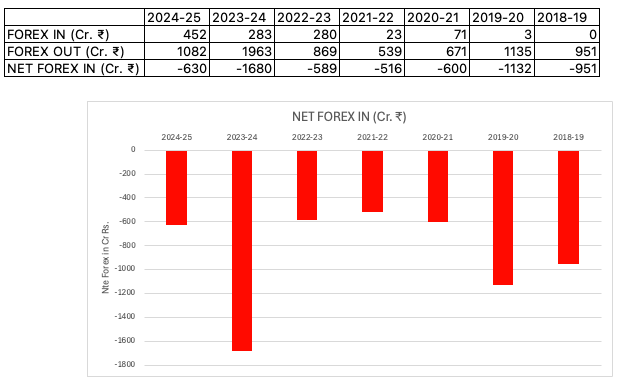
Source: CSL annual reports https://cochinshipyard.in/Investor
The Bigger Picture
Despite these adverse practices, large shipyards present themselves as saviors of MSMEs through extensive public relations campaigns. In reality, they are eroding the foundation of MSME boatyards.
If the government genuinely aims to support MSMEs and promote a self-reliant India (Aatmanirbhar Bharat), it must address these systemic issues, ensure a level playing field, and empower MSMEs to thrive in the competitive landscape.
MSMEs frequently work to localise the creation of technology, and MSME boatyards won’t just assemble imported boat parts unlike large shipyards. Despite all of these tactics, these massive shipyards present themselves as the nation’s MSMEs’ saviours through a robust public relations effort. In reality, they are just destroying the MSME boatyards.
- https://sandith.in/2020/02/11/how-govt-policies-inadvertently-discriminates-msmes/
- https://sandith.in/2020/07/12/aatmanirbhar-in-theory-and-practice-1/ there are 4 parts
- https://www.thehindubusinessline.com/opinion/not-easy-for-msmes-to-be-aatmanirbhar/article32405631.ece published in Business Line
- https://www.business-standard.com/article/pti-stories/cochin-shipyard-to-build-three-marine-ambulances-for-ker-govt-118053101383_1.html
- https://www.newindianexpress.com/business/2018/jan/31/csl-forays-into-fishing-vessels-construction-1766011.html
- https://currentaffairs.bankexamstoday.com/2022/11/iwai-signs-mou-with-csl.html
- https://www.thehindu.com/news/cities/Kochi/kochi-corporation-trying-to-form-spv-to-run-ro-ro-vessels/article38206214.ece
- https://www.theweek.in/news/biz-tech/2022/07/05/grse-inks-pact-with-west-bengal-govt-for-construction-of-next-ge.html
- https://shipmin.gov.in/sites/default/files/MAJOR%20ACHIEVEMENTS%20FOR%20THE%20MONTH%20OF%20NOVEMBER%2C%202022.pdf
- https://economictimes.indiatimes.com/epaper/delhicapital/2022/may/01/sunet-bottomline/india-to-build-hydrogen-fuelled-vessels-at-cochin-shipyard/articleshow/91222278.cms
- https://www.irclass.org/media-and-publications/news/indian-register-of-shipping-to-provide-classification-services-to-six-hybrid-electric-catamarans-for-inland-waterways-authority-of-india/
- https://www.thehindu.com/news/cities/Kochi/pact-for-third-ro-ro-vessel-signed/article68864769.ece
 Sandith Thandasherry