
A quirky banking habit hiding a centuries-old story of mathematical conquest and distrust.
Picture this: you sit down to write a cheque. You fill in “100” in the little box, and then, right below it, you dutifully write “One hundred rupees only.” Why? The numbers are right there. Is anyone worried you can’t count?
As it turns out — yes. And the story behind this peculiar habit is one of the most fascinating episodes in the history of mathematics: a tale of a world-changing Indian invention, European stubbornness, and a banking convention that has outlasted the very problem it was designed to solve.
India’s Gift to Arithmetic
The digits you use every day — 0, 1, 2, 3, 4, 5, 6, 7, 8, 9 — are the product of one of humanity’s greatest intellectual leaps, and it happened in India. This system introduced two revolutionary ideas simultaneously: a symbol for nothing (zero, or ’shunya’ in Sanskrit), and place value — the idea that the position of a digit determines its magnitude. The ’1’ in 10 means something entirely different from the ’1’ in 100, purely because of where it sits.
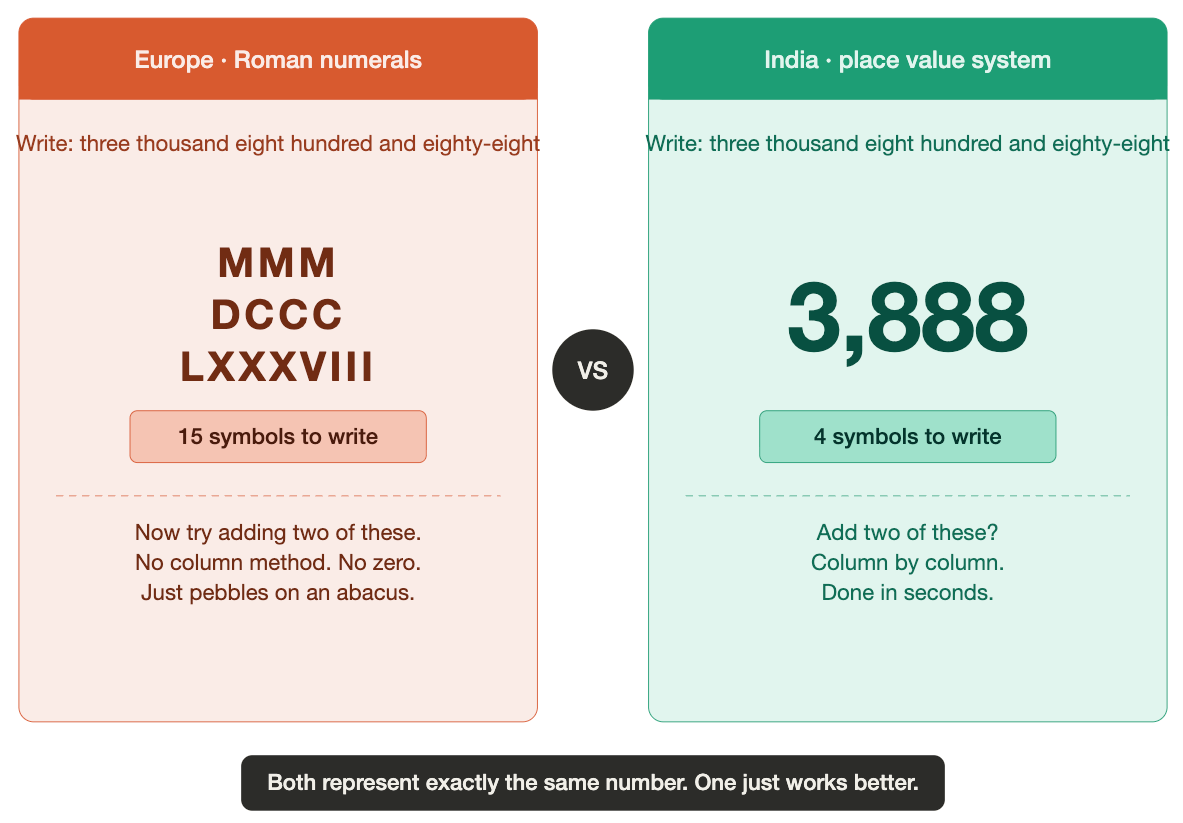
This was not obvious, and it was not universal. Roman numerals, which Europe used for over a millennium, were purely additive — like pebbles on a counting board. XVII meant 10+5+1+1=17, and to write 1,999 you had to scratch out MCMXCIX. As C. K. Raju writes in The Funny History of Arithmetic, early Greeks and Romans “were stuck: they knew only the names of small numbers” and could not go beyond a myriad (ten thousand) — a number they regarded as practically uncountable. The word ’myriad’ itself reveals this: it meant both “ten thousand” and “countless” in Greek, because ten thousand was, to them, the edge of comprehension.
Meanwhile, the ancient Indian Yajurveda (17.2) already named numbers up to a ’parardha’ — a trillion — with full positional clarity. As Raju demonstrates, this was not coincidence. It was the direct result of the decimal place-value system, in which “each place indicates a value ten times that of the preceding.” Indians had been using this system since Vedic times — not as an abstraction, but as a living tool of commerce, astronomy, and philosophy.
The Long Road Westward
The Arithmetic Revolution in Europe began in the 10th century when a soon-to-be pope introduced Christian Europe to Indian arithmetic — imported from Muslim Europe, hence the misleading label “Arabic numerals.” By the 9th century, Arab scholars, particularly Al-Khwarizmi in his treatise ’On the Calculation with Hindu Numerals’ (ca. 825 CE), had already carried this system westward. The mislabelling stuck, obscuring the debt ever since.
In 1202, Leonardo of Pisa — known today as Fibonacci — published ’Liber Abaci,’ championing the Hindu system for European merchants. He had grown up in North Africa watching Arab traders outpace their European counterparts with effortless calculation. He was dazzled and wanted Europe to catch up. But as Raju makes clear, the driving force behind what followed was not enthusiasm — it was conflict, born of “hubris, due to deep-seated European assertions of their own supremacy through religious/racist prejudice enmeshed with a systematically false history.”
The First Math War
Europe was not immediately impressed. The resistance was fierce and, at times, official. In 1299 — nearly a century after Fibonacci’s advocacy — the city of Florence actually banned Indian numerals in banking. Merchants and accountants were ordered to keep using Roman numerals in their official ledgers.
The stated reason was fraud. A ’1’ could be turned into a ’7.’ A ’0’ could become a ’6’ or a ’9.’ But as Raju argues, this reasoning is itself the tell: Europeans were simply not yet fluent in reading or writing these numerals. The problem was not the numerals — it was European unfamiliarity with them.
Raju calls this struggle “the first math war” — the war of abacus against algorismus (Indian arithmetic). Many Christian Europeans “kept foolishly asserting the superiority of their own manifestly inferior Graeco-Roman pebble arithmetic, based on the abacus. They persistently struggled to prove the impossible, to prove the superiority of their inferior pebble arithmetic over Indian arithmetic, right until the end of the 19th century.” This war was driven not by rational disagreement but by Christian supremacist belief — Europeans could not bring themselves to accept that they had something fundamental to learn from India.
The difficulty was conceptual as much as practical. The Indian system — what Raju calls ganita, practical computation — was relational and dynamic. Zero was not the absence of a number; it was a number carrying positional meaning. European mathematics, rooted in the additive Greek and Roman tradition, had no framework for this. The result was centuries of misunderstanding, half-adoption, and institutional resistance.
Enter the Cheque
The first British cheque was issued in 1659. This was the very era when Indian numerals had technically ’won’ the debate — but Europe was still developing a stable, shared hand for writing them. A ’3’ written by one person looked nothing like a ’3’ written by another. Cheques — written orders to a banker to pay a specific sum to a specific person — were instruments of trust passed between strangers who might never meet.
The solution was to write the amount twice: in numerals (for quick reading and sorting) and in words (as a tamper-resistant backup). “One hundred rupees” is very difficult to quietly alter. But ’Rs. 100’ can become ’Rs. 1,000’ with a single comma and zero, or the leading digit can be changed with a single pen stroke. In cases of dispute, banks were instructed to honour the amount written in words.
The Beautiful Irony
Here is the delicious irony at the heart of this story. The reason words were needed on cheques was that Europeans did not fully trust — or fully understand — a number system they had been handed by Indian mathematicians. A system so elegant, so compact, and so powerful that its very conciseness made it easy to tamper with in the hands of a population still growing into it.
Indian mathematics — rooted in practical ganita — had no such problem. Merchants and astronomers in India had been fluent in place-value arithmetic for centuries. But when Europe adopted the system incompletely, translating the notation without fully absorbing the conceptual framework, it created exactly the kind of ambiguity that fraud exploits.
Raju’s central insight in “The Funny History of Arithmetic” is that Europe’s centuries-long struggle with elementary arithmetic was not incidental — it was the inevitable result of hubris. “Because of their immense false pride,” Raju writes, “Europeans just could not bring themselves to accept the simple fact of the superiority of Indian arithmetic.” That false pride encoded itself into global banking law.
The next time you laboriously spell out “One hundred and fifty” on a cheque, know that you are performing a ritual born from medieval Europe’s discomfort with India’s greatest mathematical gift.
References
C. K. Raju, The Funny History of Arithmetic, Kant Academic Publishers, 2026.
C. K. Raju, Cultural Foundations of Mathematics: The Nature of Mathematical Proof and the Transmission of the Calculus from India to Europe in the 16th c. CE, Pearson Longman, 2007.

