
SMM Hamburg: Still a Ships Show, Even With All the Noise
I walked SMM this year expecting decarbonisation of entire marine transport to dominate the conversation. They were everywhere. But spend enough time on the floor and a different story emerges — one that’s easy to miss if you only read the LinkedIn recaps.
The sponsors tell the real story
Look at who anchors this event. DNV – Maritime, American Bureau of Shipping (ABS), Lloyd’s Register, China Classification Society — classification societies. Everllence (the company MAN B&W became) — an engine maker. And on the coatings side, Jotun, AkzoNobel, and Nippon Paint Marine (a client of Oceanix) were all present too. The sponsors tell you where the center of gravity actually sits: the hull, the class rules, the engine room, the paint that keeps it all running for 25 years. Everything else — decarbonisation, AI, digital twins, defense convergence — gets built around that.
India’s presence was hard to miss
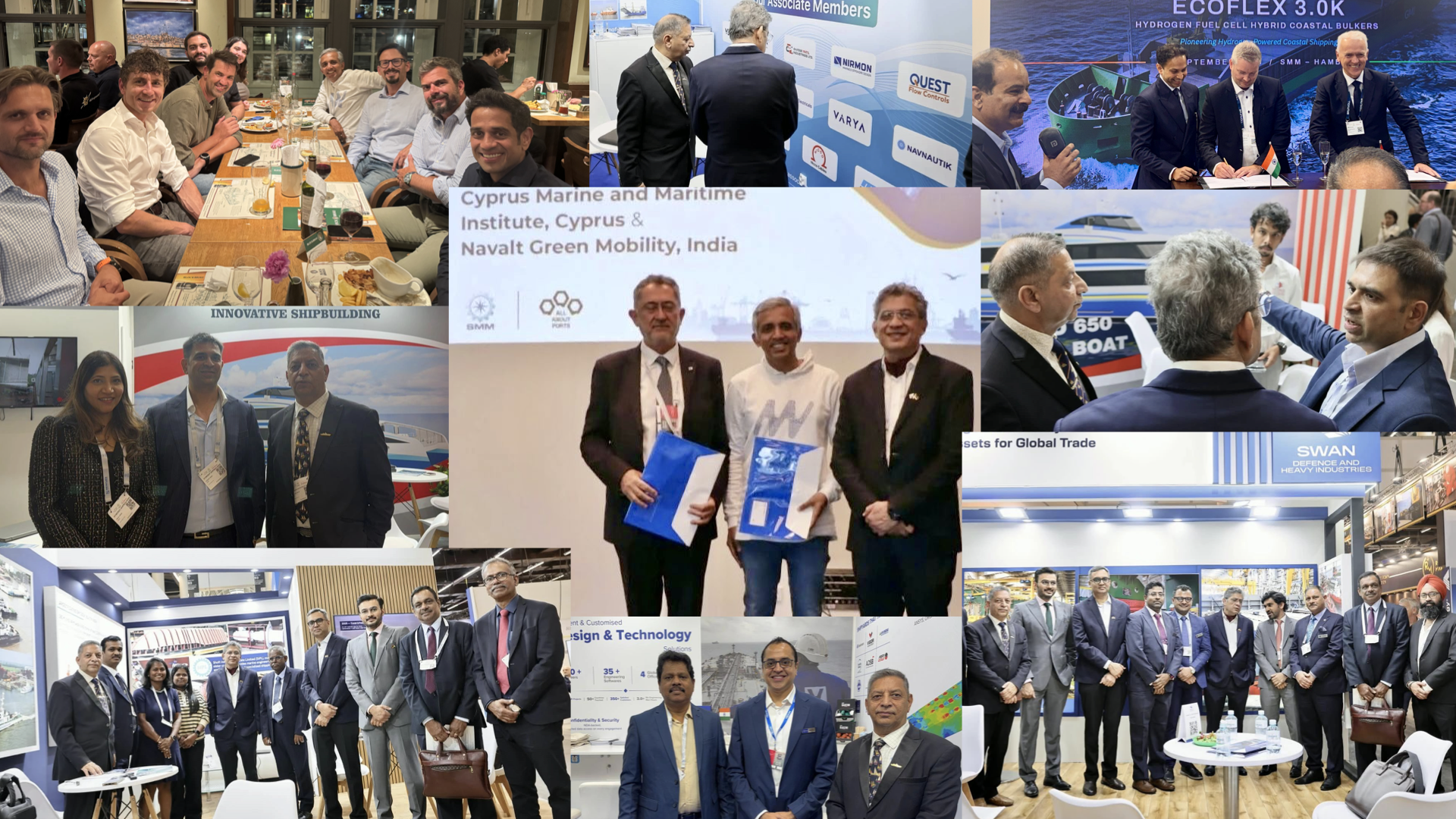
The country pavilions made this a genuinely global show, and India’s was one of the more visible ones. We were bronze sponsors through the Ministry of Ports, Shipping and Waterways (India), and a strong delegation came in led by the Shipyards Association of India and its member companies.
Indian design houses (members of Indian Marine Designers Association (IMDA) had their own moment too. Vedam Design, Smart Engineering & Design Solutions (India) Private Limited, Buoyancy Consultants, and Nirmon Marine & Offshore Design were all present — some with stalls, others announcing MOUs with leading European design houses. Design capability is a quieter story than shipbuilding capacity, but it’s arguably the more important long-term signal: it means Indian firms are being brought into the room at the concept stage, not just the fabrication stage. We exchanged our own MOU with our European partner, CMMI – Cyprus Marine and Maritime Institute, this time with the blessing of the Govt. of Cyprus and Govt. of India.

Wind is the green technology that actually took off
Among large-ship decarbonization technologies, wind assistance has clearly moved from experimental to mainstream. Rotor sails, suction sails, and hard sails were everywhere on the floor — not as one-off demonstrators but as products with track records and repeat customers.
Decarbonization decision-support software was just as numerous, and nearly every vendor had an AI angle on it. Worth saying plainly: most of that AI framing is marketing. The underlying optimization problems — routing, trim, fuel selection — are well-understood operations research problems that predate the current AI wave. The label sells better than the substance changes.
Batteries and fuel cells: still waiting on economics
Given SMM’s large-ship focus, battery suppliers were thin on the ground — batteries make more sense at the coastal and short-sea end of the market, which isn’t where this show’s center of gravity sits. What surprised me more was how sparse fuel cells were too. The technology is proven; the economics simply haven’t caught up yet.
The one piece of real news on this front: GMI’s signing of a Hydrogen Fuel Cell Hybrid Coastal Bulker with Chowgule and Company – Shipbuilding Division, one of India’s leading shipbuilders. I spent time with GMI’s CEO discussing the numbers, and his claim was striking — at under €10/kg for hydrogen, he sees OPEX parity with diesel at roughly €2/litre, including the CO2 penalty. That’s a specific, falsifiable claim, and it happens to map closely onto a paper I published on this exact economics question. I’ll drop the link in the comments for anyone who wants to check the math themselves.

Indian shipyards are building a reputation worth protecting
Chowgule and Company – Shipbuilding Division and Cochin Shipyard Limited are doing the heavy lifting right now for how Indian shipbuilding is perceived internationally — both have a track record of timely delivery on vessels around 100 meters in length. That reputation is an asset, but it’s fragile and shared: every other Shipyards Association of India (SAI) member yard benefits from it, and every late delivery anywhere in the ecosystem erodes it a little. The opportunity for the rest of SAI’s membership is to lean into that credibility now, while it’s being actively built, rather than waiting for it to be fully established elsewhere first.
Ideas I once had, now built by someone else
Two products at SMM stopped me in my tracks — not because they were flashy, but because I’d once sketched out the exact same ideas myself, years ago, and never built them.
The first: optical sensors for shaft torque and power measurement that don’t need frequent recalibration (enamor.pl ). Shaft power is one of the most fundamental numbers in ship performance analytics — it’s the direct link between fuel burn and useful work — and traditional strain-gauge setups drift and demand constant recalibration to stay trustworthy. Solving that cleanly is a real problem, and Enamor has a product for it.

The second: real-time wave measurement using X-band radar already mounted on the ship (rutter.ca). Every vessel already carries this radar for navigation. Using it to also measure the sea state you’re actually sailing through — rather than relying on forecast models or buoy data — is an elegant reuse of hardware that’s already there.

Both feed directly into the kind of work we do with Oceanix — shaft power and real sea-state data are exactly the inputs that make performance analytics honest rather than modeled.
This, more than any keynote or panel, is what pulls me back to exhibitions like SMM every year. Not the headline trends everyone already writes about, but the moment you round a corner and find someone has quietly built the exact thing you once sketched on a napkin. It’s a reminder that ideas are cheap and abundant — if you can think of one, several other people already have. The only thing that was ever scarce was the will to actually ship it. More surprises await me in the next expo.

