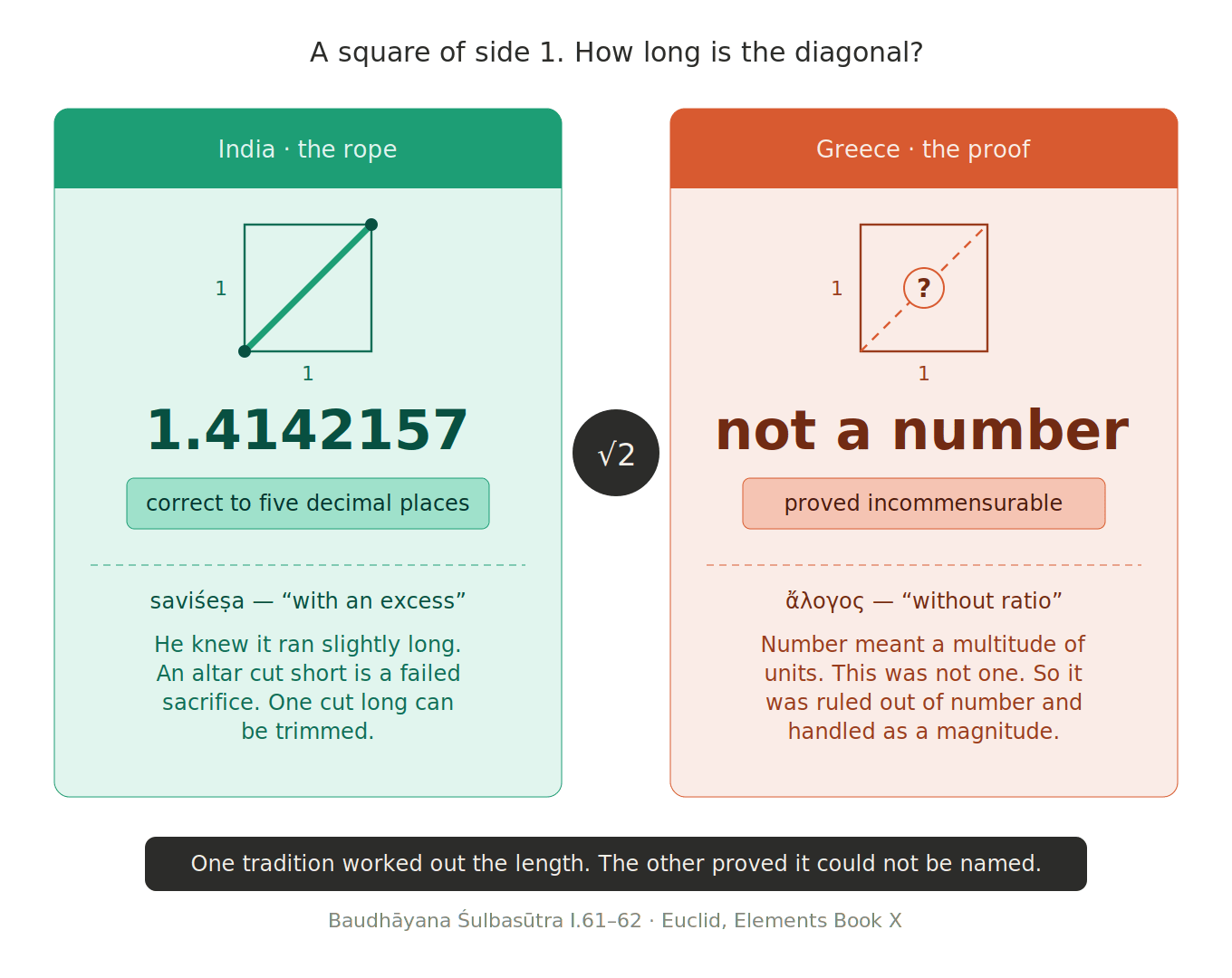

There is no evidence Pythagoras proved anything. There is a Sanskrit manual that states the rule for any rectangle — and tells you how long the diagonal is, to five decimal places.
Open any Class X mathematics textbook in India and there it is. a² + b² = c². The Pythagoras theorem. C. K. Raju counts the term repeated thirty-two times in the current NCERT text. Not once does the book mention that there is no evidence — none — that Pythagoras ever proved it, that a substantial body of scholarship holds he was not a mathematician at all, or that the clearest and most useful ancient statement of the relation sits in a Sanskrit manual written to help priests lay out a fire altar.
The Rope
The Śulbasūtras are manuals of the cord. Śulba means rope. They are appendices to the Vedic ritual texts, and they exist for a practical reason: a fire altar had to be built to an exactly prescribed area and shape, or the sacrifice failed. Geometry here is not contemplation. It is a rope pulled taut between two pegs, in the hands of a man who has to get it right.
The Baudhāyana Śulbasūtra states, at sutra I.48:
dīrghacaturaśrasyākṣṇayā rajjuḥ pārśvamānī tiryaṅmānī ca yatpṛthagbhūte kurutastadubhayaṃ karoti
“The rope stretched along the diagonal of an oblong produces by itself both the areas which the two sides produce separately.” (Thibaut, 1875)
Read it again, because three things in that sentence matter and the textbooks mention none of them.
First, it is general. Baudhāyana states the relation for the oblong — any rectangle, any proportions. The familiar triples, 3 and 4, 5 and 12, 8 and 15, come afterwards and are explicitly offered as examples of the rule rather than as the rule itself. This is very likely the earliest surviving general statement of the relation anywhere in the world.
Second, it is about a rectangle and its diagonal, not a triangle and its hypotenuse. That is the practical formulation, and Raju is right to insist on the distinction. A man laying out an altar is working with a rectangle, and the diagonal is what he has to measure to know his rectangle is true. The diagonal cuts it into two right triangles anyway, so nothing is lost — but the rope-stretcher’s version tells you what the rule is for.
Third, it is a rope. Not a diagram, not a proof, not an object of contemplation. A length of cord that has to be cut to a particular length this afternoon.
Honesty requires a caveat, and I would rather supply it than have it supplied for me. Nobody can date the Śulbasūtras precisely. Estimates run from 800 to 500 BCE, and as S. G. Dani observes, “all dates seem to be quite speculative”. On the early figures Baudhāyana precedes Pythagoras by three centuries; on the late ones they are near contemporaries. What is not in doubt is that the Indian statement owes nothing to Greece.
Then Cut the Rope
Here is the question the textbooks never ask, and it is the one that matters. Draw a rectangle five units by seven. The relation tells you the square on the diagonal is 25 plus 49, which is 74. Fine. Now cut the rope. How long is it?
a² + b² = c² does not give you c. It gives you c². Getting from one to the other needs a square root, and square roots of ordinary numbers are almost never whole. The relation is a statement about areas. Turning it into a length — the only thing a surveyor, a shipwright or a priest laying an altar actually wants — is a separate and much harder problem. Raju’s name for it is the “Pythagorean calculation”, as distinct from the Pythagorean theorem, and he notes that nobody in the Western story ever mentions it.
Baudhāyana mentions it. A few sutras later he gives the rule: increase the measure by its third, and that third by its own fourth less the thirty-fourth part of that fourth. Work it out and you get 577/408, or 1.4142157. The true value of √2 is 1.4142136. He is correct to five decimal places.
And he names the error. He calls the value saviśeṣa, “with an excess” — he knew it ran slightly long. That is exactly the error you want, because an altar cut short is a failed sacrifice and an altar cut long can be trimmed. This is a man who has thought about what happens when his number is wrong.
None of this troubled the Indian tradition in the slightest. It was a rope. It had a length. Here is the length, to the precision the job needs, and here is which way it errs. That attitude — that a number is something you compute to the accuracy required — runs from the Śulbasūtras through to Aryabhata, who in 499 CE writes down a general digit-by-digit procedure for extracting the square root of any number at all: the same method still taught by hand today.
The Man Who Left No Paper Trail
So where does Pythagoras come into it? Barely, is the answer.
He lived roughly 570 to 490 BCE and wrote nothing. Not a line survives, and no source in the first two centuries after his death suggests a work by him ever existed. His contemporaries do mention him. Xenophanes tells a joke about him stopping a man beating a puppy because he recognised in its yelping the soul of a dead friend. Heraclitus calls him a polymath and a fraud, “chief of the charlatans”. Herodotus brings him up in connection with burial customs and the immortality of the soul. Not one of them mentions geometry. Neither does Plato, nor Aristotle. And Eudemus of Rhodes — Aristotle’s own pupil, the first historian of geometry — wrote the history of the subject and gave Pythagoras no place in it.
The first surviving text linking him to any geometrical discovery is Cicero’s, in 45 BCE, four and a half centuries later, and Cicero says he does not believe it. Plutarch, around 100 CE, quotes the old epigram about the ox sacrificed for the discovery and admits he does not know which discovery it commemorates — this relation, or a quite different problem about the application of areas. In another work he says he prefers the second. The earliest author to quote the tradition is unsure what the tradition is about.
And Proclus, writing around 460 CE, introduces the attribution with one of the quietest demolitions in the history of mathematics: “If we listen to those who wish to recount ancient history, we may find some of them referring this theorem to Pythagoras.” He then says he admires the author of the Elements far more, for actually proving it. Elsewhere Proclus catalogues the early geometers and credits Pythagoras with the theory of proportionals and the five regular solids — not with this theorem. Walter Burkert’s Lore and Science in Ancient Pythagoreanism (1972) remains the standard work, and calls the whole reputation “a distortion of perspective”. No ancient source anywhere credits Pythagoras with having proved any theorem at all.
The Greek Answer Was to Refuse the Question
The Greek tradition did meet the diagonal, and what it did with it is the most revealing thing in this story.
It proved that the diagonal of a square is incommensurable with its side — that no ratio of whole numbers can express it. (The tale that the man who let this out was drowned at sea is late and unreliable, told eight centuries afterwards by two Neoplatonists, one of whom does not name him and the other of whom gives three contradictory versions.) The mathematics is real and it is magnificent. But for the Greeks arithmos, number, meant a multitude of units, and a thing that was not a multitude of units was not a number. So √2 was not admitted as a number at all. It was reclassified as a magnitude and handled geometrically.
The consequences run right through Euclid. The Elements carries two entirely separate theories of ratio — Book V for magnitudes and Book VII for numbers — which share almost nothing, because incommensurables cannot be made to live inside the second. Book X then sorts thirteen mutually exclusive species of irrational line, the medial, six binomials, six apotomes, and never computes a single one of them. It is extraordinary machinery for reasoning about a length while never producing it.
Set that beside saviśeṣa. Confronted with a rope whose length was awkward, one tradition sharpened the arithmetic until it had five decimal places and a note on which way the error ran. The other redefined number so that the awkwardness lay outside it.
The Argument That Actually Matters
The reflexive Indian response to all of this is nationalist: they took it from us, rename it the Baudhāyana theorem. Raju explicitly refuses that move, and he is right to. “The chronological priority is irrelevant,” he writes. “The real claim to be contested is that Greeks did math in a superior way.”
That is the load-bearing myth. Not that the Greeks were first — every serious historian concedes they were not — but that they alone lifted the relation from a mere calculation into a proved theorem, and that proof is a higher order of knowledge than computation. Babylon and India merely knew; Greece understood. The priority is quietly surrendered and the superiority retained. That is the whole trick, and it is why renaming the theorem would change nothing.
Ask about the calculation instead, and the hierarchy inverts. The tradition credited with the theorem is the one that ruled the answer out of the category of number altogether. The tradition dismissed as merely practical is the one that could cut the rope.
Even the proof is thinner than advertised. Its case rests on Proposition I.4, which the Elements establishes by picking one triangle up, laying it on another, and observing that they coincide. Bertrand Russell said so a century ago, and Hilbert wrote the Grundlagen in 1899 precisely to supply what Euclid lacked. Raju goes further, arguing that “Euclid” never existed and that the elevation of axiomatic proof over empirical reasoning was a political requirement of the Crusading church. Those belong to his thesis rather than to settled history — but the gap in I.4 is not in dispute.
And So Back to the Cheque
Europe inherited the Greek half of this and not the useful half. Medieval masons did find diagonals, but by construction rather than calculation — rotate a square inside a square and the diagonal appears, no arithmetic required — or by rational stand-ins, 5 to 7 for √2, or the old reliable triples. A theorem, and no way to cash it.
What arrived with al-Khwarizmi’s book on Indian calculation around 825, and crawled into Europe through Fibonacci and the abbaco schools over the following three centuries, was not the ability to find a diagonal. It was the ability to find any diagonal, on any numbers, by the same written routine, by anyone taught the procedure. That is the difference between a craft secret and a technology. And as the first post in this series described, Europe fought it for three hundred years before giving in.
So the theorem that carries a Greek name became usable only once Indian numerals arrived to carry it. Before that it was a true statement about areas that nobody in Europe could turn into a length.
The relation has no owner, and I am not interested in claiming one. But if a name is going to be hung on it, the record is not ambiguous about who stated it plainly, who worked out what the rope actually measured, and whose arithmetic the rest of the world ended up using. What Greece contributed was the name — and the name arrived roughly a thousand years late, attached by writers who admitted they were repeating stories they could not verify, about a man whose own contemporaries remembered him for talking to dogs.
The next time a child in a classroom writes “by Pythagoras theorem” at the head of a sum and reaches for a calculator to finish it, she is using two inheritances at once, and the textbook has named the wrong one. The rope came first. It always did.
Further Reading
- C. K. Raju, The Funny History of Arithmetic, Kant Academic Publishers, 2026.
- C. K. Raju, Cultural Foundations of Mathematics: The Nature of Mathematical Proof and the Transmission of the Calculus from India to Europe in the 16th c. CE, Pearson Longman, 2007.
- S. N. Sen and A. K. Bag, The Śulbasūtras, Indian National Science Academy, 1983 — the standard edition and translation.
- S. G. Dani, “Ancient Indian Mathematics: Śulbasūtras — A Mathematical Review” — careful, unsentimental, and honest about the dating problem.
- Kim Plofker, Mathematics in India, Princeton University Press, 2009.
- C. K. Raju, “The term ‘Pythagorean theorem’ is false history — should go from our school texts”, Medium — medium.com/@c_k_raju
- C. K. Raju, “Decolonising mathematics”, Arumeru Journal of Culture and Thought, Parts 1 and 2 — the peer-reviewed statement of the argument, including the distinction between the “Pythagorean theorem” and the “Pythagorean calculation”.
- Walter Burkert, Lore and Science in Ancient Pythagoreanism, Harvard University Press, 1972 — the work that dismantled Pythagoras the mathematician.
- Carl Huffman, “Pythagoras”, Stanford Encyclopedia of Philosophy — the current mainstream summary of the evidence.

