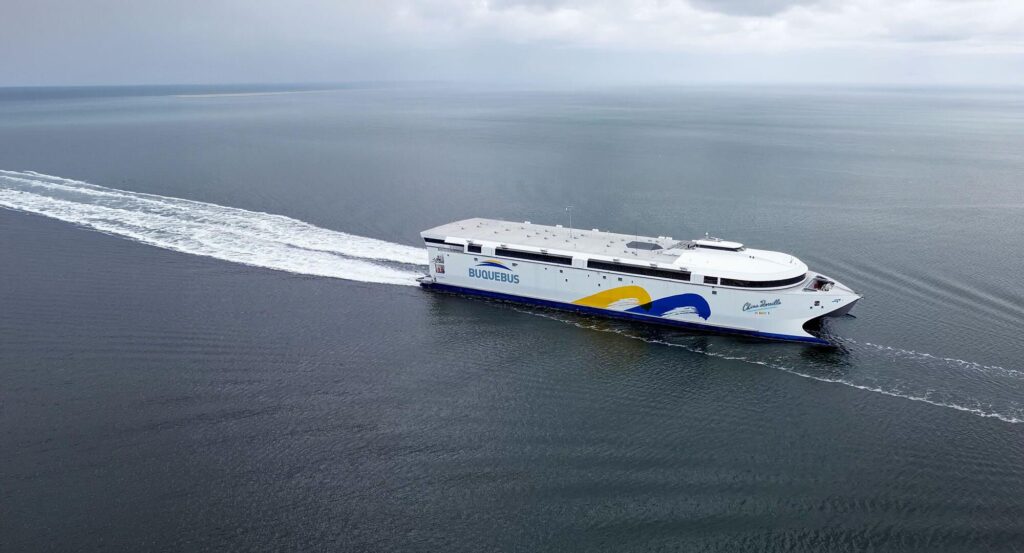

The China Zorrilla is called the world’s largest battery-electric ship. That is true. The question I care about is different. Does it make commercial sense?
She is a 130 m RoPax catamaran. She carries 2,100 passengers and 225 cars between Buenos Aires and Colonia del Sacramento. She has a 41.2 MWh battery, eight 2.4 MW motors and eight waterjets. She makes four crossings, each 57.5 km, a day at 25 knots.
I modelled her in the economics module of https://solarboats.build/economics against an equivalent MGO-fuelled ferry. I used public data. Where data was not public, I made assumptions and I state them here.
I always look at ferry economics at two levels. The first is the choice of ship. Electric or diesel? For that, only costs matter, so I compare the total cost of ownership, plain and discounted. The second is the route. Does the service pay for itself? For that, revenue comes in and I look at the project NPV. Many public transport routes are not meant to pass the second test. It is good when one does.
The route makes the case. It is 57.5 km one way. It is fixed and it runs at high frequency. The ship charges after every crossing. So the battery is sized for one leg plus reserve, not for days of autonomy. Battery-electric ferries are not limited by battery technology alone. They are enabled by how they are operated.
Start with the choice of ship. The electric ship is reported at US$200 million. The original 130 m Incat design for Buquebus was contracted at about US$130 million in 2019 as a diesel-LNG vessel. The switch to battery came midway through the project, so the hull and outfit did not change. With escalation, I put the conventional comparator at US$150 million.

The electric ship costs US$50 million more, about a third extra. That premium buys the battery, the power electronics, the electric propulsion and the readiness to charge.
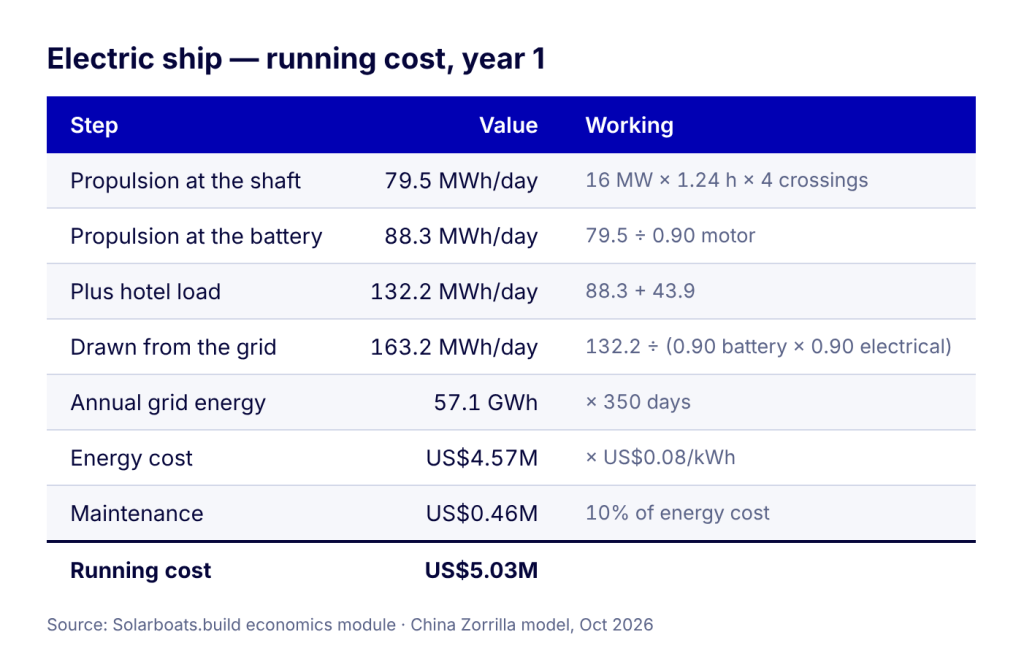
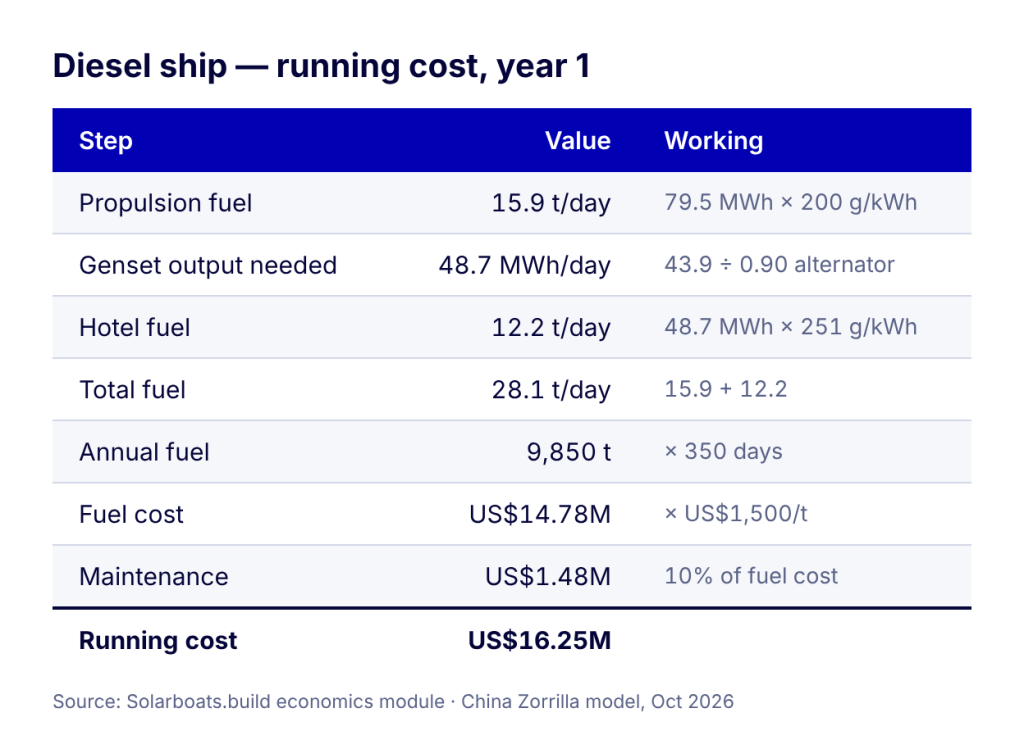
Running cost starts from the duty cycle, and both ships do the same work. A 57.5 km crossing at 25 knots takes about 75 minutes at 16 MW. Four crossings need 79.5 MWh a day at the shaft. The 4 MW hotel load runs at sea and through each 90-minute berth stay, about 11 hours a day, or 43.9 MWh. What differs is how each ship turns that work into a bill.
For the electric ship, I took motor, battery and electrical-system efficiencies at 90% each. I priced electricity at US$0.08/kWh, a 50:50 blend of large wholesale-user prices in Uruguay (US$0.088) and Argentina (US$0.065), rounded up. Argentine prices swing with gas imports, so this is the number most worth stress-testing.
For the diesel ship, I used a 200 g/kWh main engine at its best load, and 250 g/kWh gensets with 90% alternators for the hotel load. MGO is at US$1,500/tonne.
Crew, revenue and everything else the two ships share stay out of this comparison. They do not change the answer.
The electric ship saves US$11.2 million a year. Its energy and maintenance bill is 31% of the diesel one. A large, volatile fuel bill becomes a small, predictable power bill. That is the whole economic argument for electrification, in one line. From year 2, I escalate fuel at 5% a year and electricity at 3%, so the gap widens.

The battery is where the risk sits. Take 41.2 MWh at 80% depth of discharge. Hold back 20% for degradation. That leaves about 26.4 MWh usable at end of life. One crossing, with the hotel load on shore power at berth, takes about 27 MWh out of the battery. So the pack is already short before it reaches end of life. If it also carries the hotel load at berth, it is short even when new. There is no room for headwinds, a late departure or a slow charge. Either the drivetrain is better than the 90% efficiency I assumed, or the pack comes out before it loses a fifth of its capacity.
Corvus claims a ten-year life. Four cycles a day for 350 days is 1,400 cycles a year, or 14,000 cycles in ten years. That is a tall claim for an NMC pack worked this hard. I assumed replacement in year 10 at about a third of the original battery cost, or US$10.3 million. It does not break the case. But a ferry model that ignores battery replacement overstates the case for electrification.
Over 20 years, discounted at 10%, with fuel escalating at 5% a year, electricity at 3%, the battery replaced in year 10 and a 10% residual value, this is how the two ships compare.
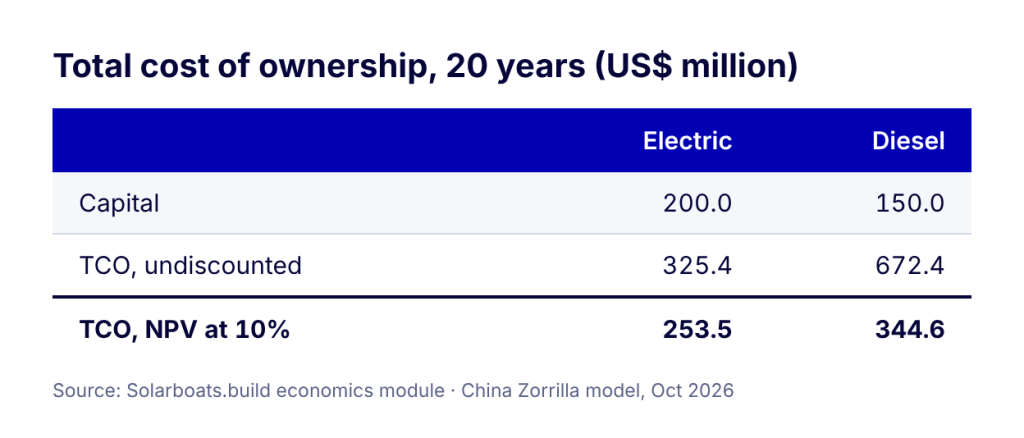
The simple payback on the US$50 million premium is 4.5 years. Discounted, she breaks even with diesel in 5.3 years and ends US$91 million ahead. The premium earns about 27% a year.

The case is not fragile. Each line below is the value at which the answer flips, with everything else held.

That still leaves out shore charging. Putting about 25 MWh back in a 90-minute turnaround, while carrying the hotel load, needs roughly 20 MW at each terminal. Public reports put the electrical works at Colonia alone at about US$20 million. Charge US$40 million to the electric ship for both ends and she is still about US$50 million ahead.
So the first question is settled. On cost, electric beats diesel on this route.
The second question is whether the route pays for the ship. This is where revenue comes in. At US$50 a passenger, US$200 a vehicle and 60% load, tickets bring in about US$126 million a year. I let fares rise 5% a year and left duty-free and food out. Crew is 100 per set, two sets, at an estimated US$50 a day, all year. That is about US$3.65 million. Revenue and crew are the same for both ships. That is why they stayed out of the first question.
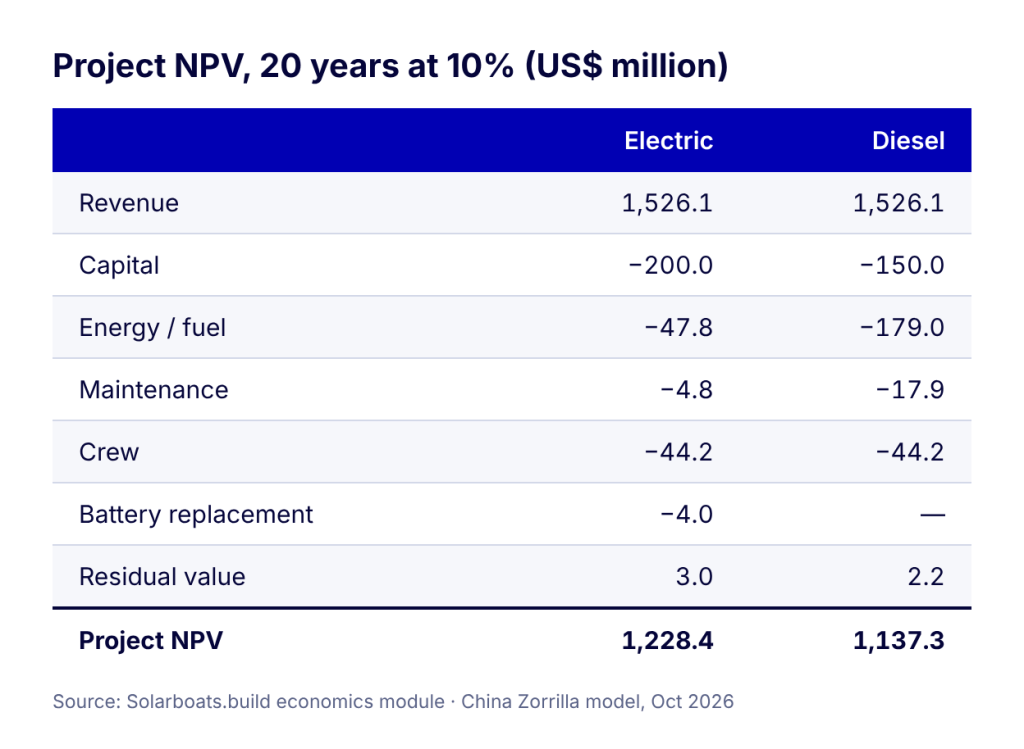
Both ships make money on this route. The electric one makes US$91 million more, the same gap as in the first question, as it must be. Diesel shows the higher IRR, 76% against 64%, because it ties up less capital. When the choice is between two ways of serving the same route, NPV is the better measure.
Those returns are too good to be the whole story. The model carries only energy, maintenance and crew. Port and terminal charges, insurance, the shore organisation, sales, taxes and financing are not in it. So I read the project NPV as a ceiling. The more useful number is how far revenue can fall before the NPV reaches zero. For the electric ship, that happens at about 12% load against the 60% I assumed. For diesel, at about 15%. There is a lot of room for the costs I left out.
Many public transport routes will fail this second test and still be worth running. A city ferry with low fares exists to move people, and someone subsidises it. For those, the first question is enough. It is better when a route passes both. Buenos Aires–Colonia does.
The emissions saving is real but not zero. Argentina’s grid is at 346 gCO2/kWh. Uruguay’s is at 81. A 50:50 blend gives 214 gCO2/kWh. On the 57 GWh she draws from the grid, the electric ship emits about 12,200 tonnes of CO2 a year against 31,600 for diesel. That is 19,400 tonnes saved every year, and about 387,000 tonnes in 20 years. Charging more in Uruguay, or buying renewable power in Argentina, would push it further.

So the China Zorrilla works. She works because several things line up. The route is short and fixed. The speed is moderate. The ship runs four times a day. There is power at both ends. The revenue base is large. The fuel she replaces is expensive. And the ship was designed around the battery. Take away any one of these and the numbers get harder.
The future of large electric ferries will not be decided by battery headlines. It will be decided route by route, with two questions. Is electric cheaper than diesel over the life of the ship? Does the route pay for the ship? Between Buenos Aires and Colonia, the answer to both is yes. On your route, calculate it. Do not assume it.
Download the China Zorilla input file for using in the https://solarboats.build/economics platform from the forum – https://solarboats.discourse.group/t/china-zorilla-the-worlds-largest-electric-ferry/21/3

