
The question
A friend called me last week with a problem I had not faced before. He runs a tanker fleet and has signed newbuilding contracts with a yard in China for product and chemical tankers. During contract finalisation, the yard made an unusual offer. They would guarantee either the cargo deadweight or the cargo tank volume. Not both.
He wanted to know which one to take. We talked it through on the call, and the answer turned out to be more interesting than the question.
Why a yard will not guarantee both
Start with what each number depends on. Once the hull form is fixed, the displaced volume at a given draft is fixed. That fixes the displacement, which is the total weight of ship plus everything on board. Subtract the lightship and you get deadweight. Subtract fuel, fresh water, stores and the constant, and you get cargo deadweight. So cargo deadweight depends on two things: the outer shape, and how heavy the yard builds the ship.
Cargo volume depends on something else entirely. It is set by the inner geometry: the longitudinal bulkheads, the inner hull, the transverse bulkheads, the tank top and the deck. These are all fixed by the structural drawings.
The two are linked only through cargo density. An owner who plans for a certain cargo needs enough volume to carry it up to the full deadweight. If either number falls short, the ship carries less than it was bought to carry. That is why a yard is reluctant to guarantee both. Each guarantee exposes the yard to a different kind of construction risk.
The two options
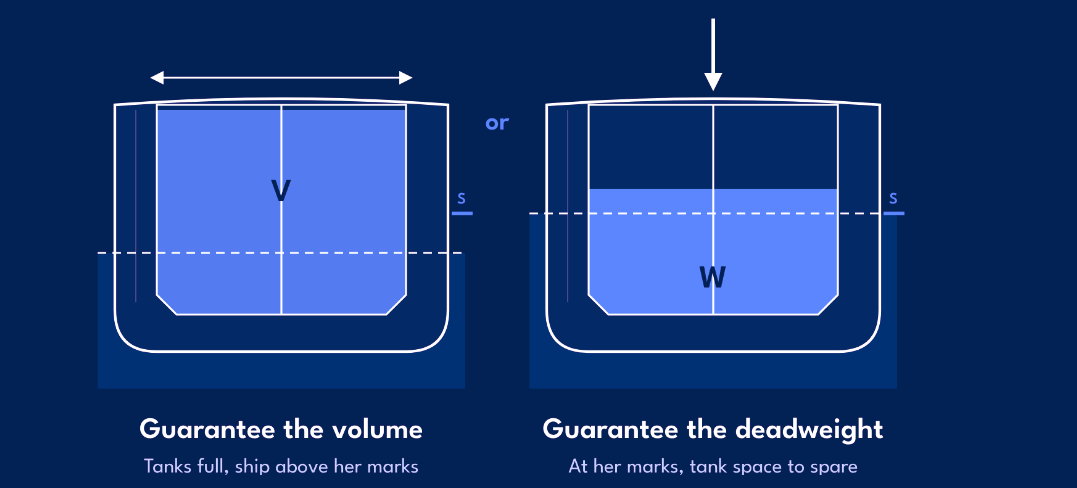
The first option is to take the volume guarantee. The yard promises the cargo tank capacity, and deadweight is left to fall where it falls.
This is an easy promise for a yard to keep. Tank volume comes straight from geometry. If the yard builds to the approved drawings, the bulkheads, deck heights and tank tops are where they should be, and the volume follows. There is very little that can go wrong.
What this option leaves unprotected is weight. Lightship growth during construction is the real risk at any yard: heavier plates than calculated, extra outfitting, weld metal, paint, piping. Every tonne added to the lightship is a tonne taken from cargo deadweight. With only volume guaranteed, the yard pays nothing for that overrun. The owner absorbs it, every voyage, for the life of the ship.
The second option is to take the deadweight guarantee. Now the yard carries the weight risk. If the lightship comes in heavy, deadweight falls short, and the yard pays liquidated damages. Beyond a threshold, the owner can reject the ship. The yard has every reason to control weight.
What this option seems to leave open is volume. Imagine the inner hull of the wing cargo tanks ends up half a metre or a metre inboard of the design. The outer shape is unchanged, so displacement is unchanged. The lightship is roughly the same. Cargo deadweight is exactly as guaranteed. But the tanks are smaller. To reach that deadweight, the owner now needs a denser cargo than he planned for. With his intended cargo, the tanks fill up before the ship reaches her marks.
On paper, that is the gap. In practice, it is a small one. A bulkhead moved by a metre is not a calculation error. It is a departure from approved drawings, and the owner’s site team and class are there to catch exactly that.

Figure 1. A volume guarantee leaves weight, the real construction risk, with the owner. A deadweight guarantee moves it to the yard, and the drawings protect the volume.
Critical density
There is another way to see it. Fix the hull form and the draft, and the displacement is fixed. Construction then fixes the lightship. Add crew, stores and consumables, and the deadweight follows as an outcome. That deadweight can only be filled by two things together: cargo volume and cargo density. Once the ship is built, the volume is fixed too. So every ship has one density at which full tanks bring her exactly down to her marks.

V_cargo = cargo tank volume at 98% filling
For a cargo denser than this, deadweight is the limit. The ship reaches her marks with tank space to spare, and the volume she carries is the outcome. For a cargo lighter than this, volume is the limit. The tanks are full before she is down to her marks, and the weight she carries is the outcome. Say a tanker has 45,000 t of cargo deadweight and 52,000 m³ of cargo tank capacity. Her critical density is about 0.87 t/m³. Fuel oils and many chemicals sit above that line. Naphtha and gasoline sit below it.
Below the critical density, a ship runs out of space. Above it, she runs out of buoyancy.
This is where the two guarantees meet. A shortfall in deadweight costs the owner on every heavy cargo. A shortfall in volume raises the critical density and costs the owner on every light one. Which number matters more commercially depends on which side of that line the ship will trade.
Evidence from the fleet
I went looking at real ships. Divide summer deadweight by cargo tank capacity at 98%, and most product tankers land between 0.82 and 0.93 t/m³. Gasoline at about 0.74 and naphtha at about 0.70 sit well below that line. These ships cube out on light products. Diesel at about 0.84 sits close to balance. Fuel oil sits above. The line itself is a design choice. A US-flag MR built for light products sits at 0.76. An asphalt tanker built for heavy cargo sits at 0.99.
The most telling evidence came from my friend’s own fleet. Eight of his LR2s are sisters built to one design, and all eight have exactly 128,564 m³ of cargo tanks. Their deadweight runs from 108,914 t to 109,670 t, a spread of 756 t. The drawings held the volume to the cubic metre. The weight is what moved. That is the risk a deadweight guarantee puts back on the yard.
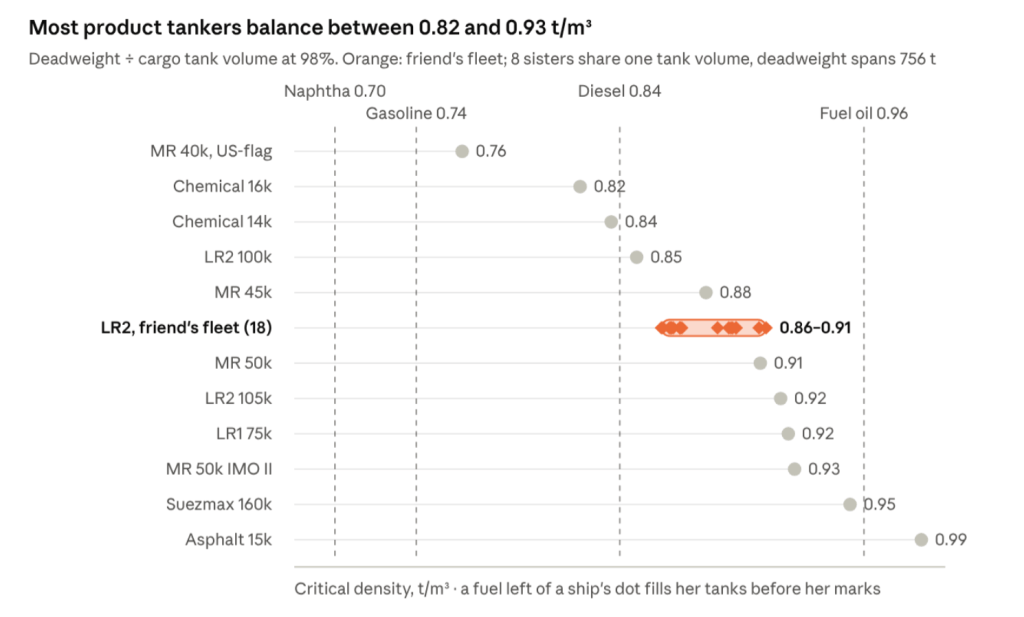
Figure 2. Critical density of 11 representative tankers and 18 LR2s from a friend’s fleet (orange band), against common cargo densities. A fuel to the left of a ship’s dot fills her tanks before she reaches her marks. Sources: Q88 forms, owner fleet lists.
Size does not set the line. Across 64 tankers below 200,000 t, from a 3,400 t coaster to a Suezmax, critical density sits in one band. What moves a ship within it is the trade she was built for, not how big she is.
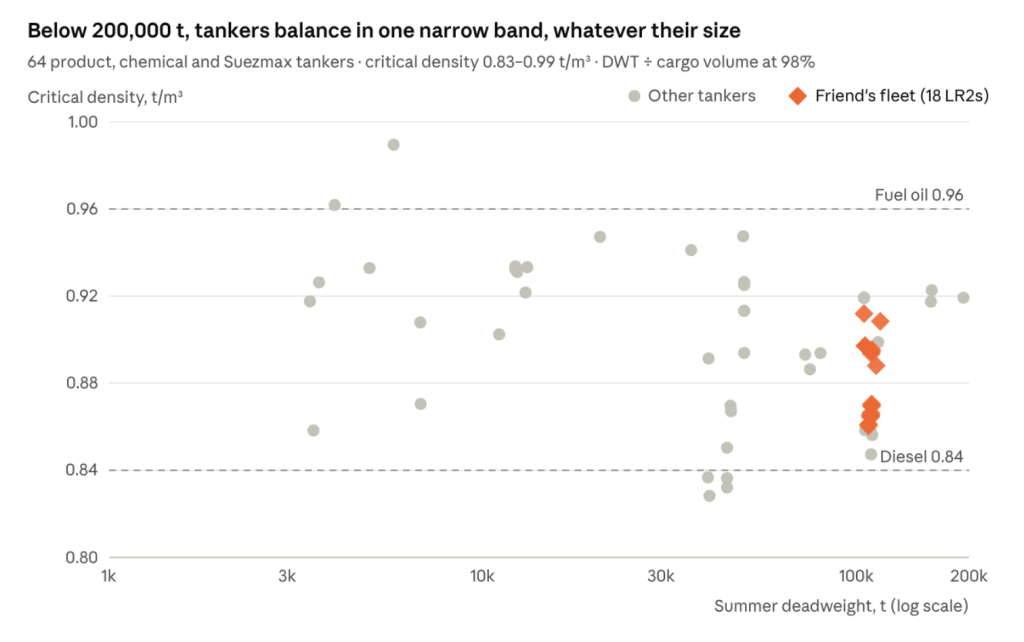
Figure 3. Critical density against summer deadweight for 64 tankers under 200,000 t, including 18 LR2s from a friend’s fleet (orange). Sulphur tankers and two outliers excluded. Sources: Q88 forms, owner fleet lists. Dataset to be extended.
Recommendation
So my advice to him was simple. Take the deadweight guarantee.
The principle is to make the yard guarantee the number it controls least. Weight is uncertain until the inclining experiment. Volume is fixed the day the structural drawings are approved. Guarantee the uncertain one, and the certain one is protected by the drawings the yard is already bound to follow. Guarantee the certain one, and the uncertain one is left with no protection at all.
Three points make the deadweight guarantee hold up. First, define it fully: the draft, a seawater density of 1.025, and every deduction from deadweight to cargo deadweight. A yard can protect a cargo deadweight figure on paper by assuming low consumables. Second, tie the capacity plan to the approved drawings with a stated tolerance, even without liquidated damages. A shifted bulkhead then becomes a non-conformity, not a commercial disappointment. Third, know your trade. Product tankers carrying light cargoes such as naphtha or gasoline usually fill their tanks before they reach their deadweight. For those owners, volume is the number that earns money. The answer does not change, because volume is protected through the drawings. But they should check the capacity plan with extra care.
It was one of those calls where a simple question pulled in everything I learnt supervising tanker newbuildings in Korea and Japan. The yard was not being unreasonable. It was offering a choice. The owner’s job is to see which choice moves risk back to the party that can control it.

