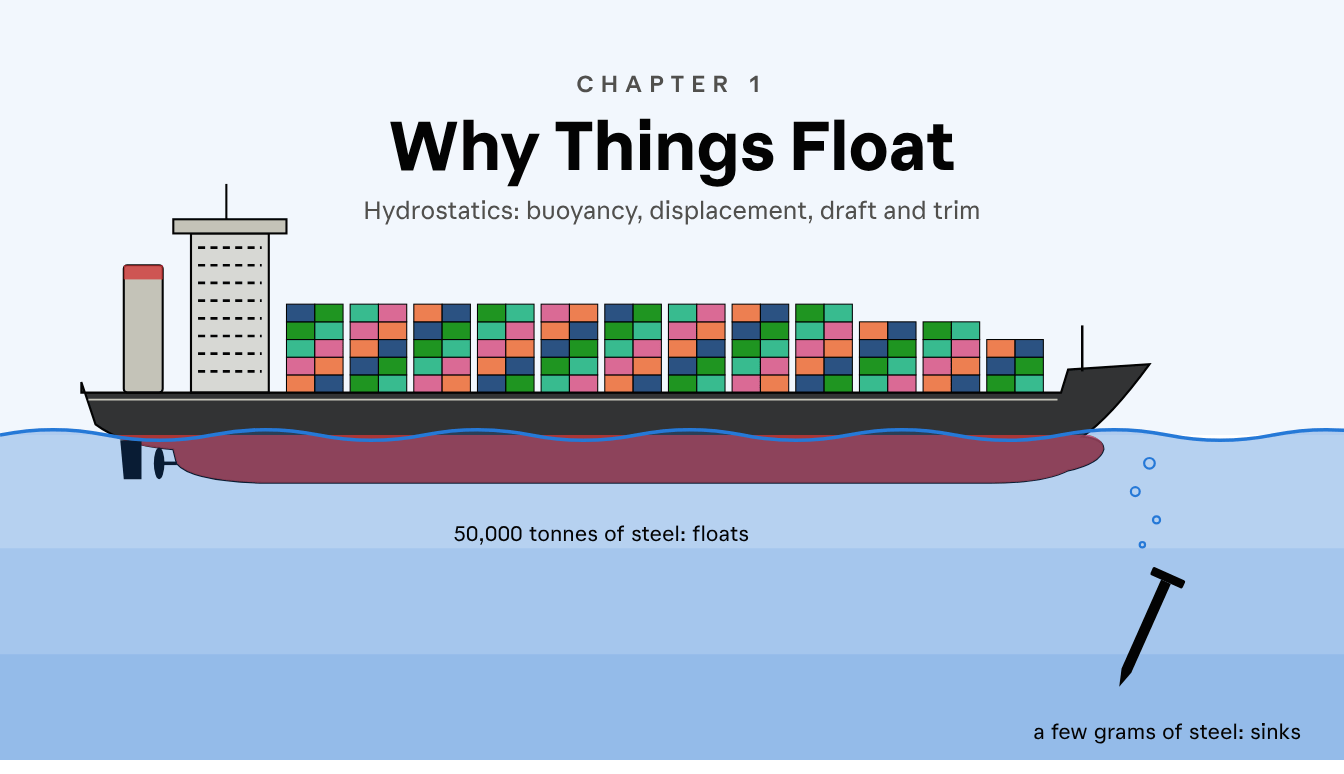

The nail and the ship
Drop a steel nail into the sea and it sinks at once. A container ship made of 50,000 tonnes of the same steel sails past and doesn’t sink.
So the steel isn’t what decides it. Something else is, and once you see it you will never look at a boat the same way. This chapter answers one question: why does anything float at all?
The big insight: a ship sinks until it has pushed aside its own weight
Put a boat on the water and it starts to sink. As it goes down it pushes water out of the way, and that water pushes back. The push grows as more of the hull goes under.
The boat stops sinking at one exact moment: when the water it has pushed aside weighs as much as the boat. Every floating thing obeys this law, from a coconut to an aircraft carrier.
A note on a famous story. Most schoolbooks credit this law to Archimedes and tell how he leapt from his bath shouting “Eureka!”. No record of that story survives from his lifetime, and it appears nowhere in his own writings. This book gives the law no hero. The water obeyed it long before anyone wrote it down.
Naval architects call that pushed-aside water the displacement. When someone says a ship “displaces 10,000 tonnes”, they are giving her weight. On a floating ship the two are the same number.
Now the nail makes sense. A cubic centimetre of steel weighs almost eight times as much as a cubic centimetre of sea water. The nail goes completely under before it has pushed aside enough water, so it keeps going down.
The ship uses the same steel in a different shape. It is a thin steel skin around a huge volume of air. Only a few metres of hull need to go under before the water pushed aside matches the whole ship’s weight.
Floating is not about what a thing is made of. It is about its average density: the total weight divided by the total volume it encloses. Below that of water, it floats. Above, it sinks.
Five things that follow
1. Add weight, and the ship sinks a little deeper. Every tonne loaded must be matched by another tonne of water pushed aside. The depth of hull below the waterline is the draft. The height of hull left above it is the freeboard. Load cargo and one grows while the other shrinks.
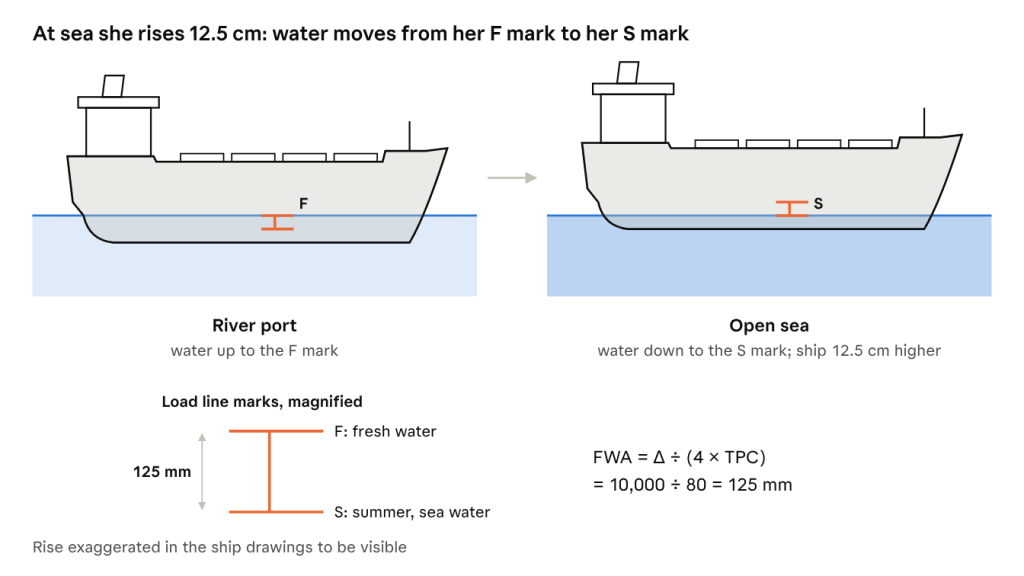
2. The same ship floats higher in the sea than in a river. Sea water carries dissolved salt, so a cubic metre of it weighs about 1,025 kg. Fresh water weighs 1,000 kg. In fresh water the ship must push aside about 2.5% more volume to match the same weight. A ship sailing from a river port out to sea rises in the water, though not one gram of cargo has moved. This is why a ship’s side carries the Plimsoll mark, a set of load lines with separate limits for fresh, tropical, summer and winter waters.
3. Each centimetre of sinking has a price in tonnes. Picture the ship slicing through the waterline like a cookie cutter. The shape it cuts is the waterplane. Sink one more centimetre and you push aside a thin slab of water the shape of that waterplane. Its weight is called TPC, tonnes per centimetre immersion. A ship with a big waterplane barely notices a few tonnes of cargo. A small boat notices every passenger.
4. The hull above the water is the life insurance. The watertight volume between the waterline and the deck is reserve buoyancy. It does no work on a calm day. When a wave sweeps the deck or a compartment floods, it is the only thing between floating and sinking. That is why rules limit how deep a ship may be loaded. Their real job is to protect the freeboard.
5. The water pushes up from one point. The buoyant force acts at the centre of the underwater volume. This point is the centre of buoyancy, B. When the ship heels, the underwater shape changes and B moves. That small shift is the whole secret of why ships stay upright, and it is Chapter 3.
A note from the electric-boat yard: on a diesel ship a few extra tonnes cost little. On a solar-electric boat every kilogram is carried on stored energy, every kilometre. Weight discipline starts here.
Trim: the seesaw you can’t see
So far the ship has sunk straight down. Real ships also tilt end to end. The difference between the draft at the stern and the draft at the bow is the trim. Deeper at the stern means trim by the stern; deeper at the bow, trim by the head.
The rule is the same as before, applied lengthwise. The ship’s weight acts down through its centre of gravity, G. The water’s push acts up through the centre of buoyancy, B. The ship settles only when G and B sit on the same vertical line. Move a heavy load aft and G moves aft. The ship tilts until the underwater shape has shifted B aft to sit under G again.
Every trim has a price, too. Moving weight along the ship creates a turning effect: the weight times the distance moved. Naval architects ask how much turning effect it takes to change the trim by one centimetre. That number is the MCTC, the moment to change trim one centimetre, in tonne-metres per centimetre. Divide the turning effect by MCTC and you have the change in trim.
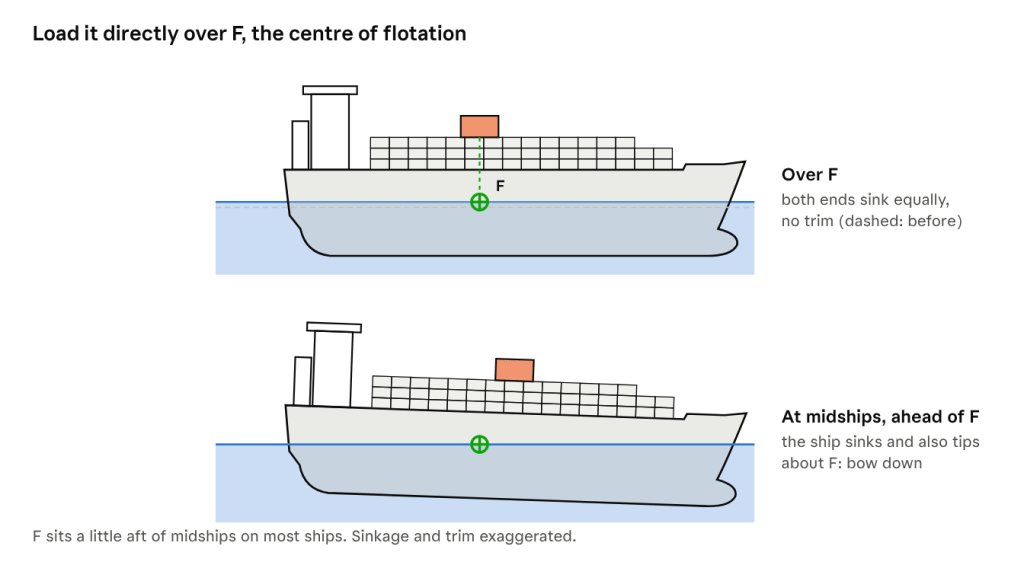
The ship doesn’t pivot about its middle. It pivots about the centre of the waterplane, called the centre of flotation, F. On most ships F sits a little aft of midships, because the stern is fuller at the waterline than the bow. Load a weight directly over F and the ship sinks evenly, with no trim at all. Load it anywhere else and it both sinks and trims.
Trim matters more than it looks. Too much trim by the head and the propeller rises towards the surface and the bow ploughs into waves. Too much by the stern and the bridge loses sight of the water ahead. Trim also changes resistance, so the right trim can save a few percent of fuel or battery energy on every trip.
Puzzles
Think before you turn to the answers. Getting one wrong first is how the idea sticks.
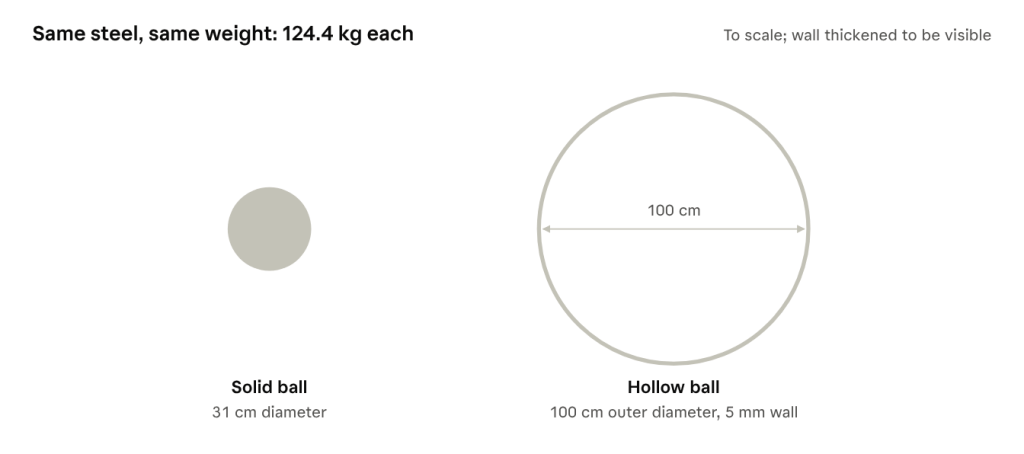
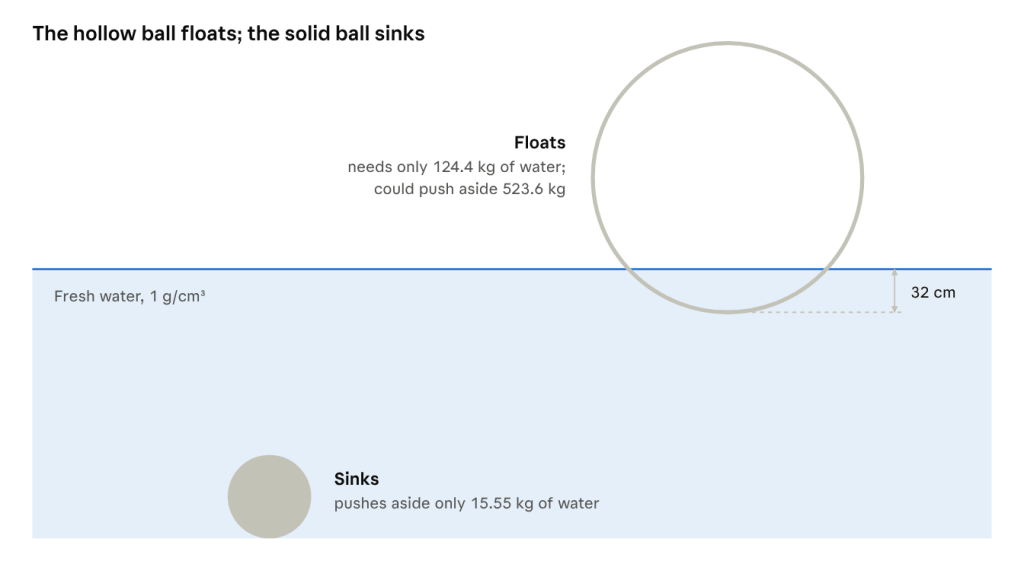
Puzzle 1 · Two steel balls (paradox) Two steel balls each weigh exactly 124.4 kg. The first is solid, 31 cm in diameter. The second is hollow: 100 cm in outer diameter, with a steel wall 5 mm thick. Both are dropped into fresh water. Take steel at 8 g/cm³ and fresh water at 1 g/cm³. Which one floats, and why?
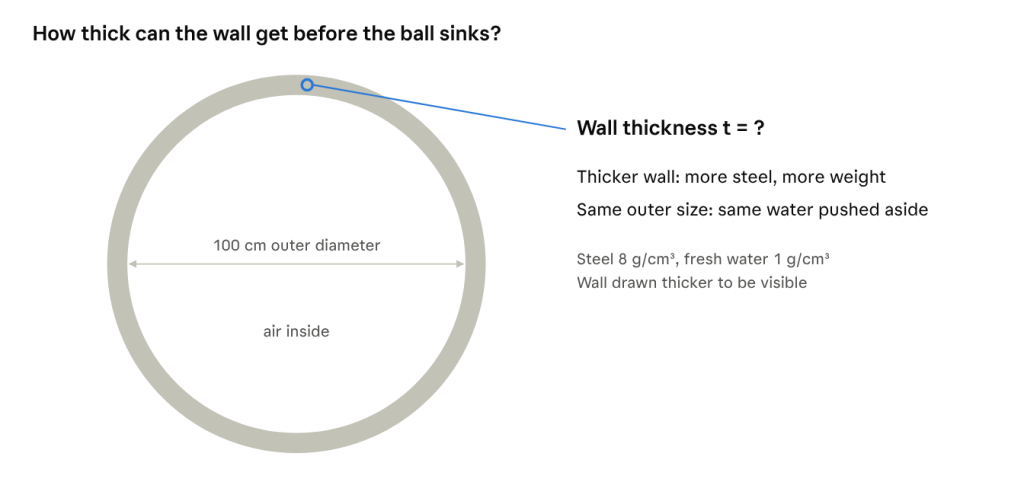
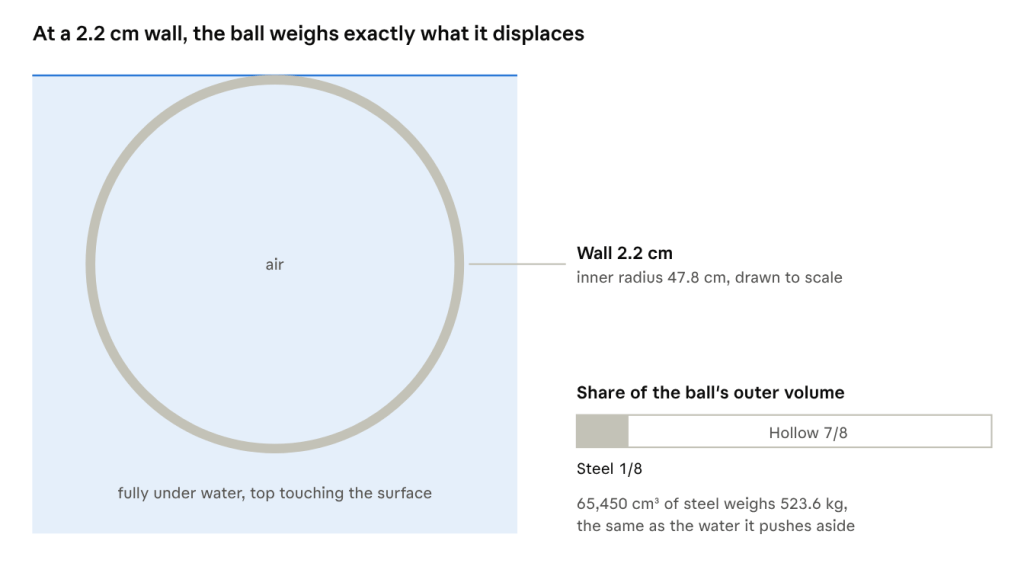
Puzzle 2 · How thick before it sinks? (napkin estimate) Take the same hollow steel ball, 100 cm in outer diameter, in the same fresh water. Make its wall thicker and thicker. At what wall thickness does it only just float, hovering fully under water? Any thicker, and it sinks.
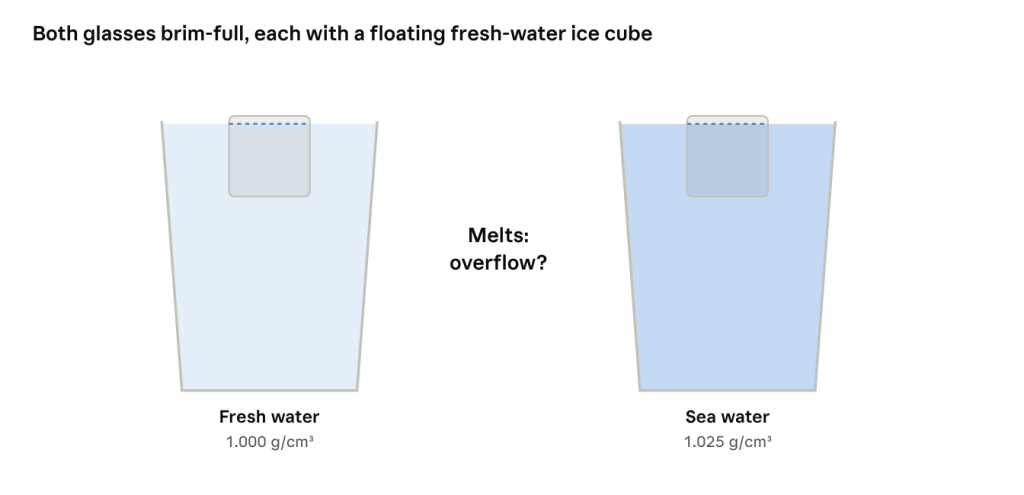
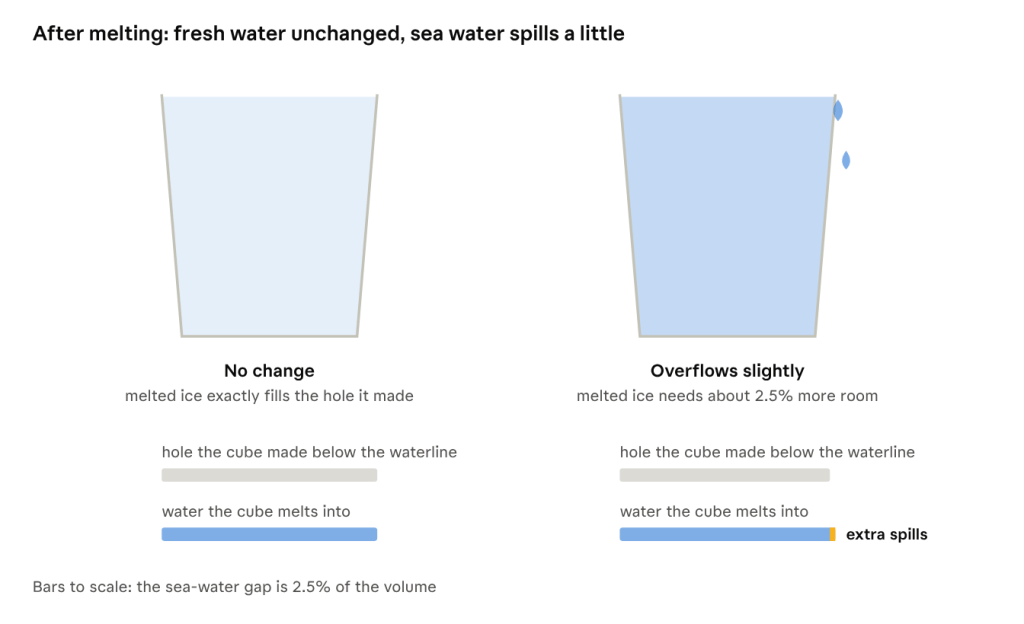
Puzzle 3 · Two ice cubes (paradox) An ice cube floats in a glass of fresh water, filled to the brim. It melts. Does the glass overflow? Now float the same fresh-water ice cube in a brim-full glass of sea water. Does that one overflow?
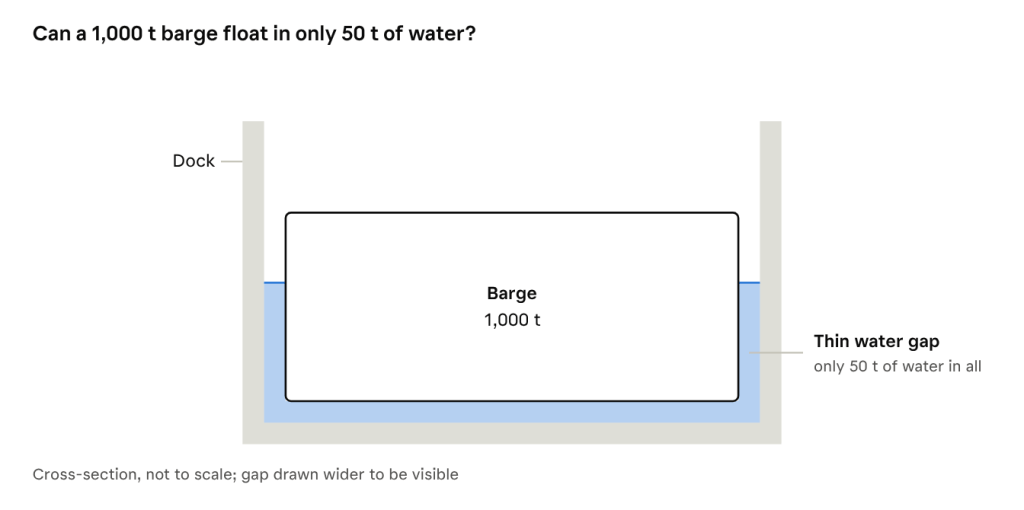
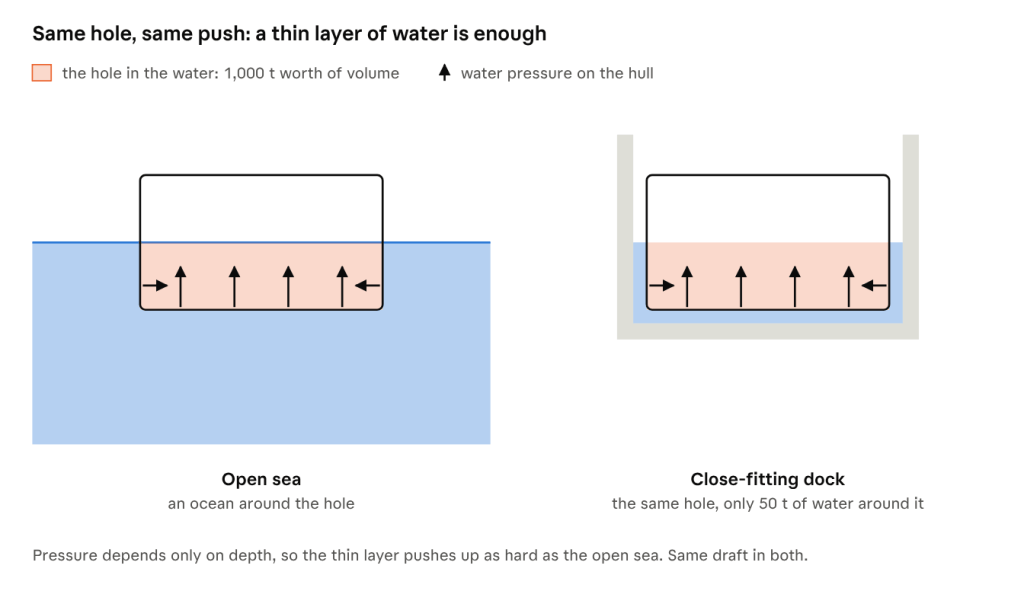
Puzzle 4 · The 1,000-tonne bathtub (paradox) A shipyard builds a dock that fits closely around a 1,000-tonne barge, leaving only a thin gap all round. Can the barge float in that dock if the water in it weighs just 50 tonnes?
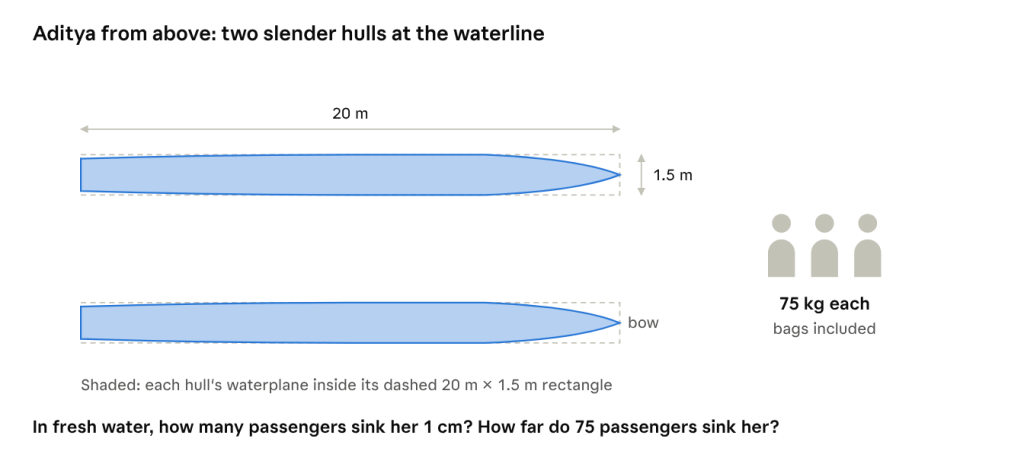
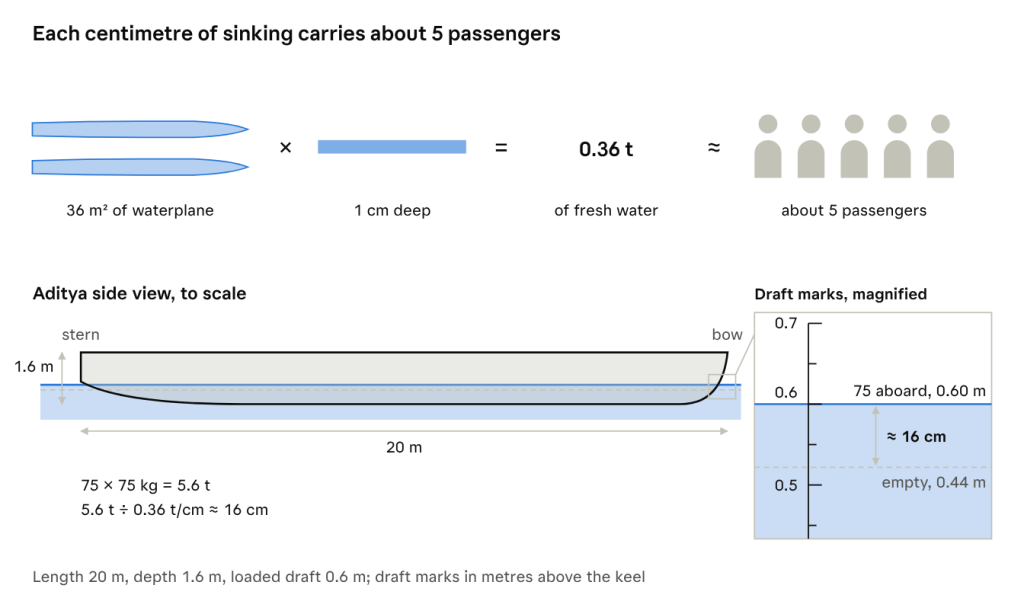
Puzzle 5 · How many passengers make a centimetre? (napkin estimate) Aditya, India’s first solar-electric ferry, is a catamaran. Each of her two hulls has a waterline about 20 m long and 1.5 m wide, and each hull’s waterplane fills about 60% of that rectangle. She runs in fresh water. Passengers weigh 75 kg each, bags included. Roughly how many must board to sink her by 1 cm? And how far does a full load of 75 passengers push her down?
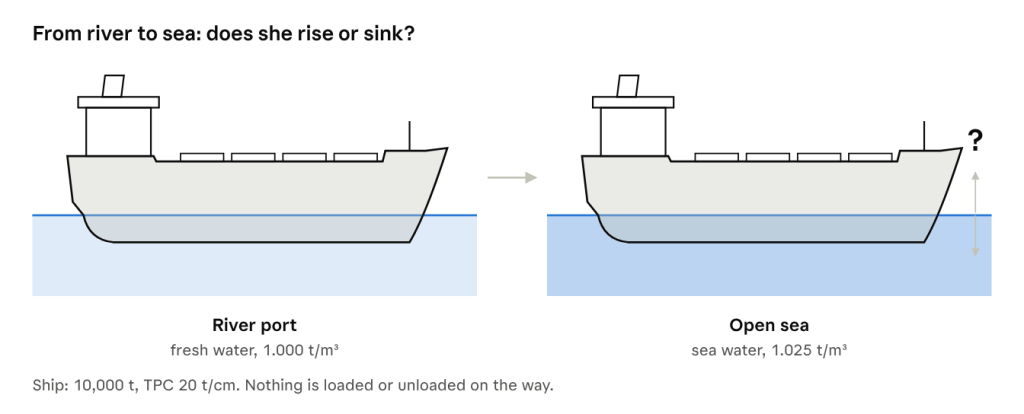
Puzzle 6 · From river to sea (napkin estimate) A ship of 10,000 tonnes loads at a river port in fresh water. Her TPC is 20 tonnes per cm. When she reaches the open sea, does she rise or sink, and by about how much?
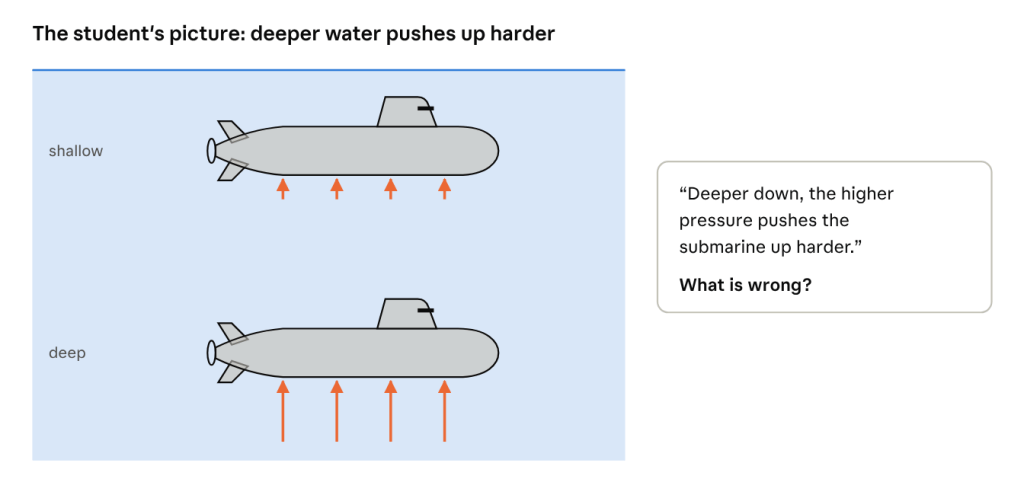
Puzzle 7 · Spot the error (find the mistake) A student writes: “A submarine floats more easily in deep water, because the higher water pressure down there pushes it up harder.” What is wrong?
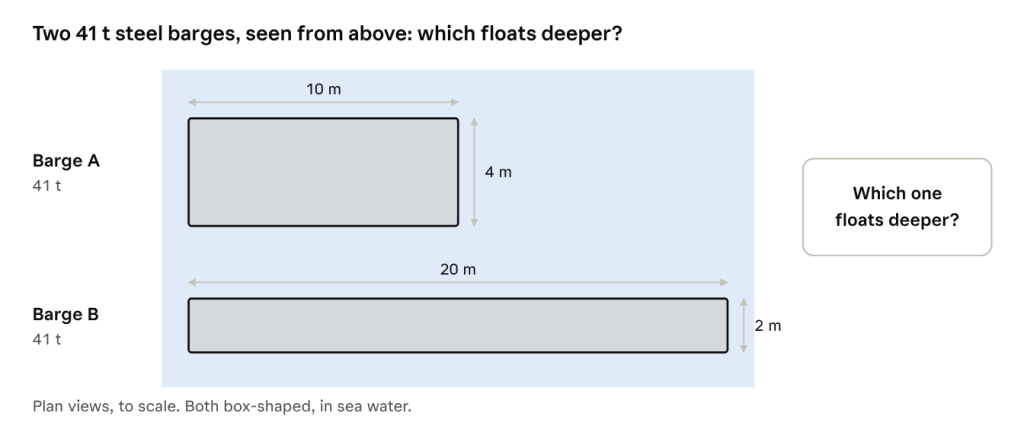
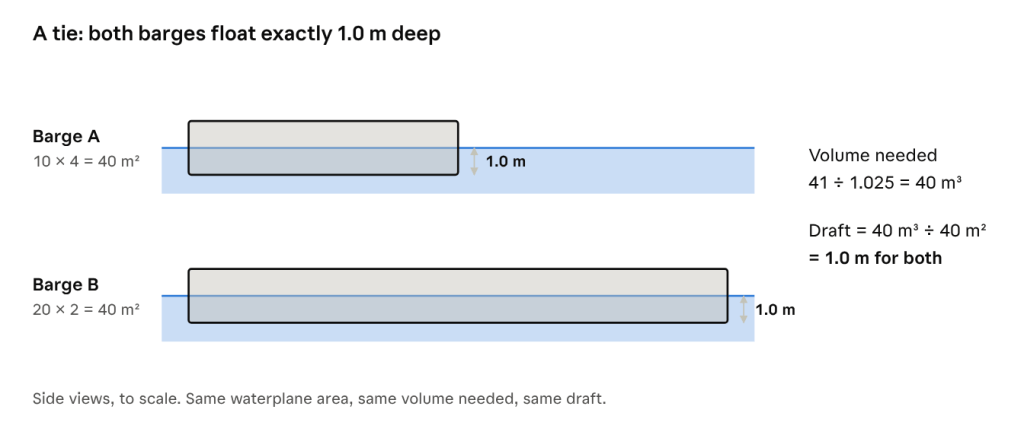
Puzzle 8 · Design duel (pick one) Two steel barges each weigh 41 tonnes. Barge A is a box 10 m long and 4 m wide. Barge B is a box 20 m long and 2 m wide. In sea water, which one floats deeper?
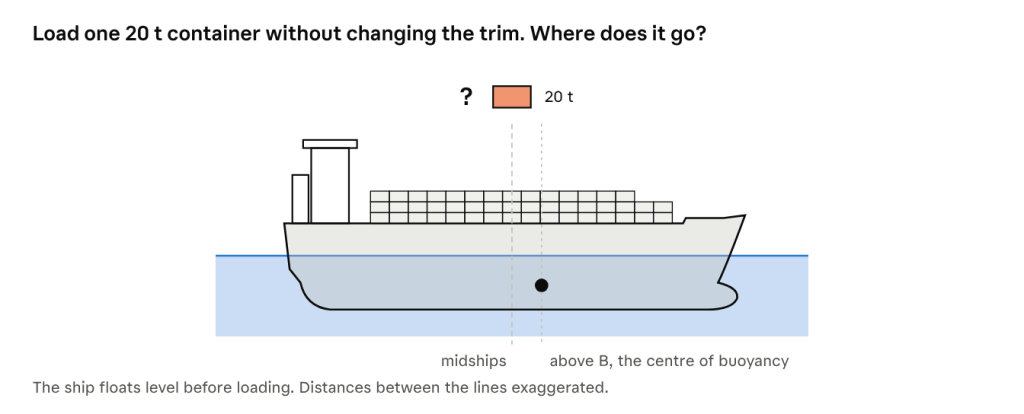
Puzzle 9 · Where does the container go? (paradox) A cargo ship floats perfectly level. The mate must load one 20-tonne container without changing the trim at all. Should it go at midships, directly above the centre of buoyancy, or somewhere else?
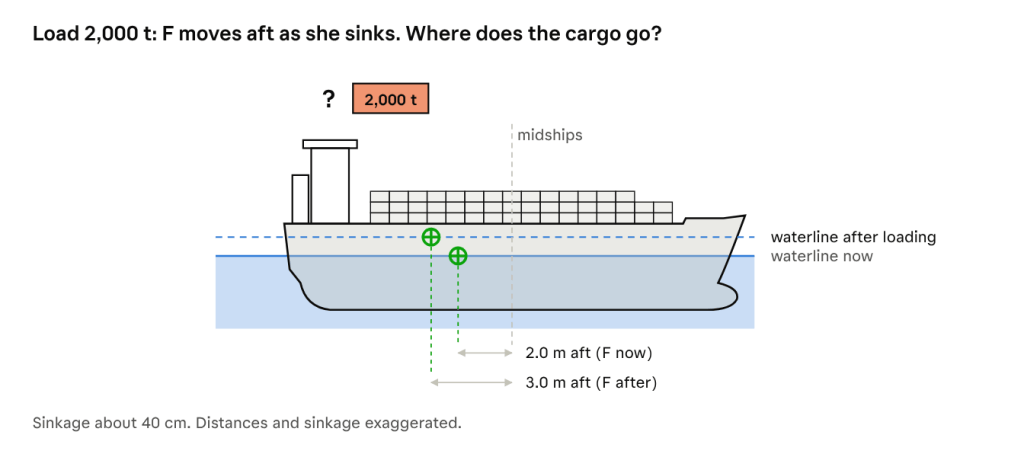
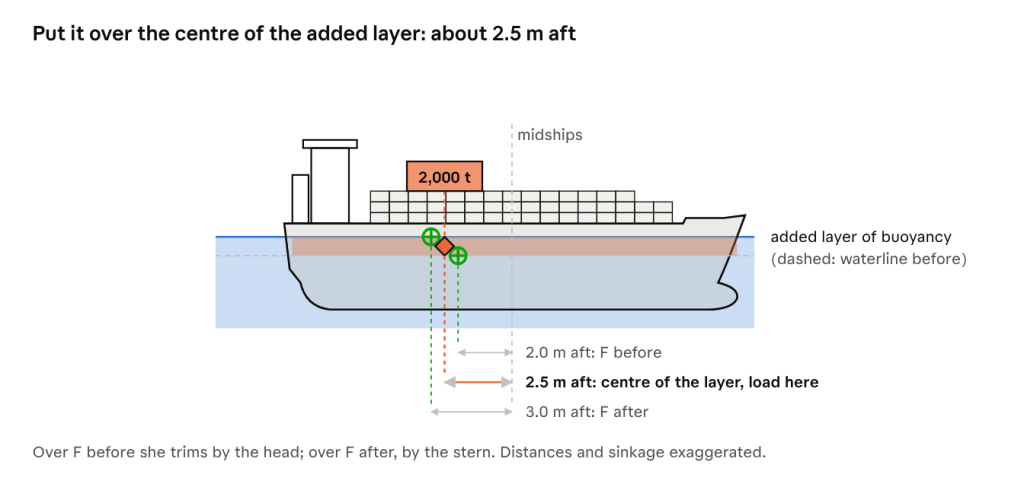
Puzzle 9b · A heavier load (follow-up) The same ship now loads 2,000 tonnes of cargo, enough to sink her about 40 cm. At her old draft, F is 2.0 m aft of midships. At her new, deeper draft, F is 3.0 m aft. Where should the centre of the cargo go so that she sinks without trimming?
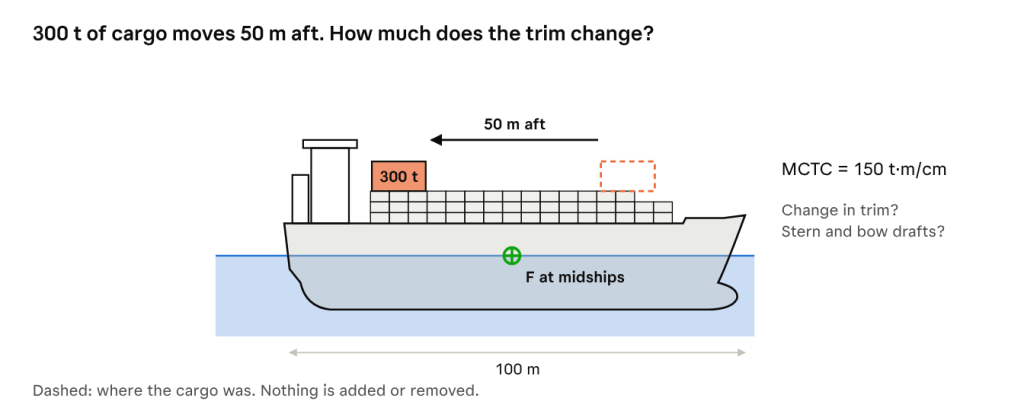
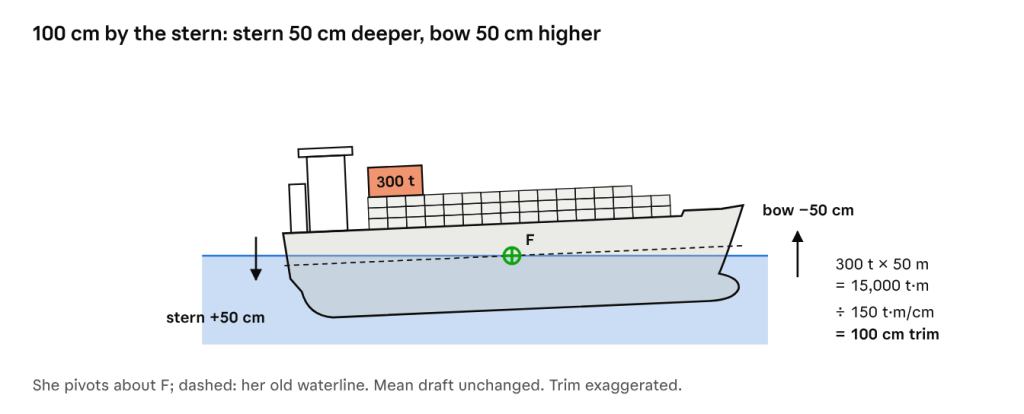
Puzzle 10 · Shifting cargo (napkin estimate) A 100 m ship has an MCTC of 150 tonne-metres per cm, and her centre of flotation is at midships. The crew moves 300 tonnes of cargo 50 m aft. How much does the trim change? How much deeper does the stern sit, and how much does the bow rise?
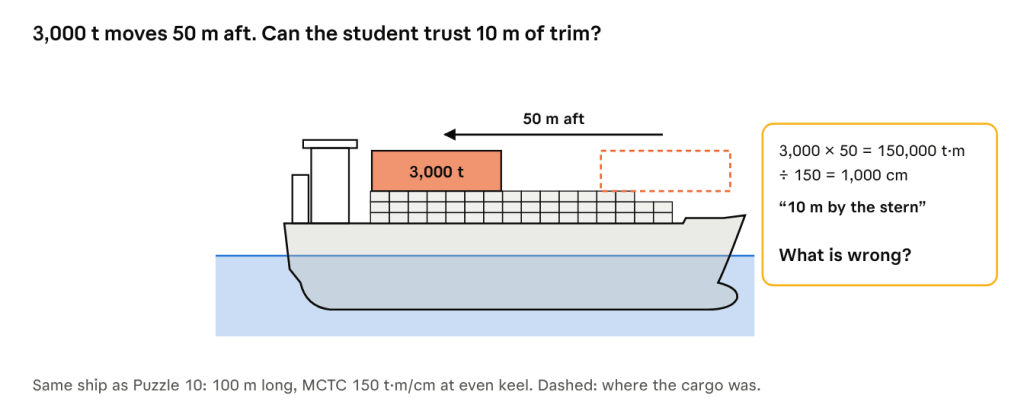
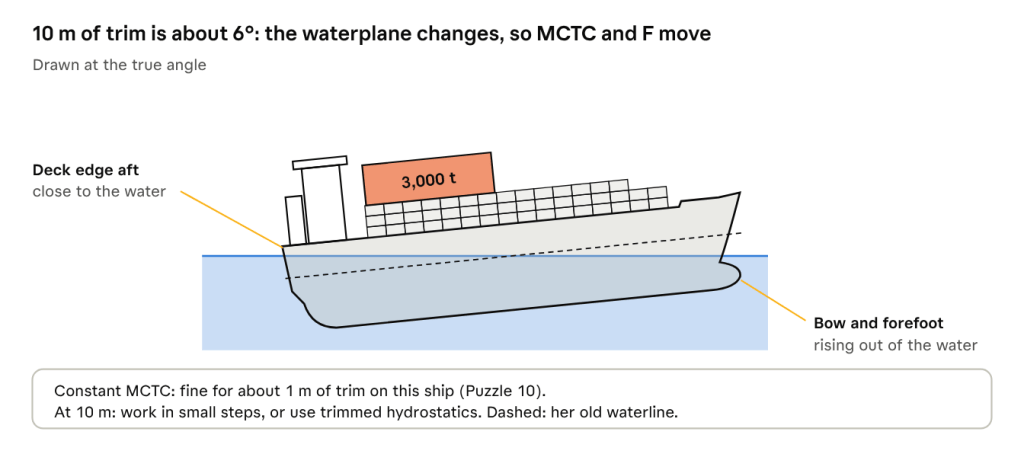
Puzzle 10b · Ten times the cargo (spot the error) On the same 100 m ship, the crew moves 3,000 t of cargo 50 m aft. A student works it out: 3,000 × 50 = 150,000 t·m, ÷ 150 = 1,000 cm. “She trims 10 m by the stern: stern down 5 m, bow up 5 m.” What is wrong with trusting that answer?
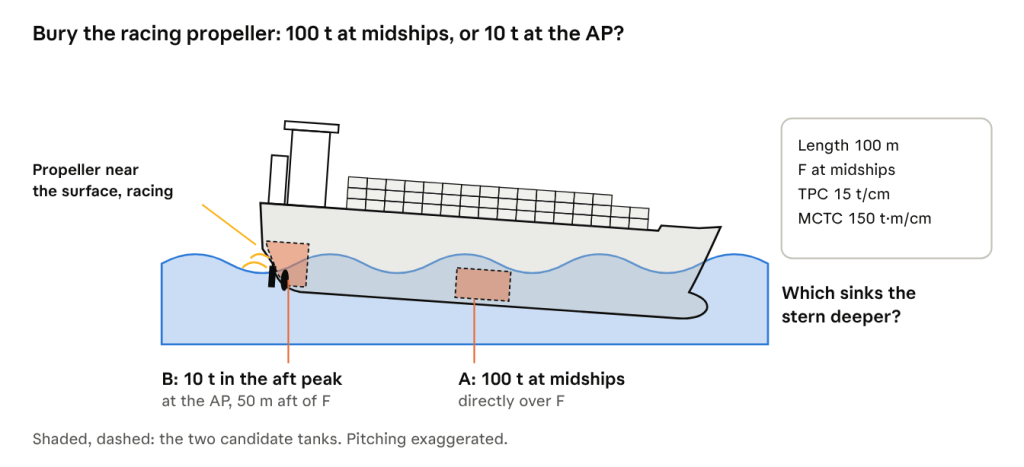
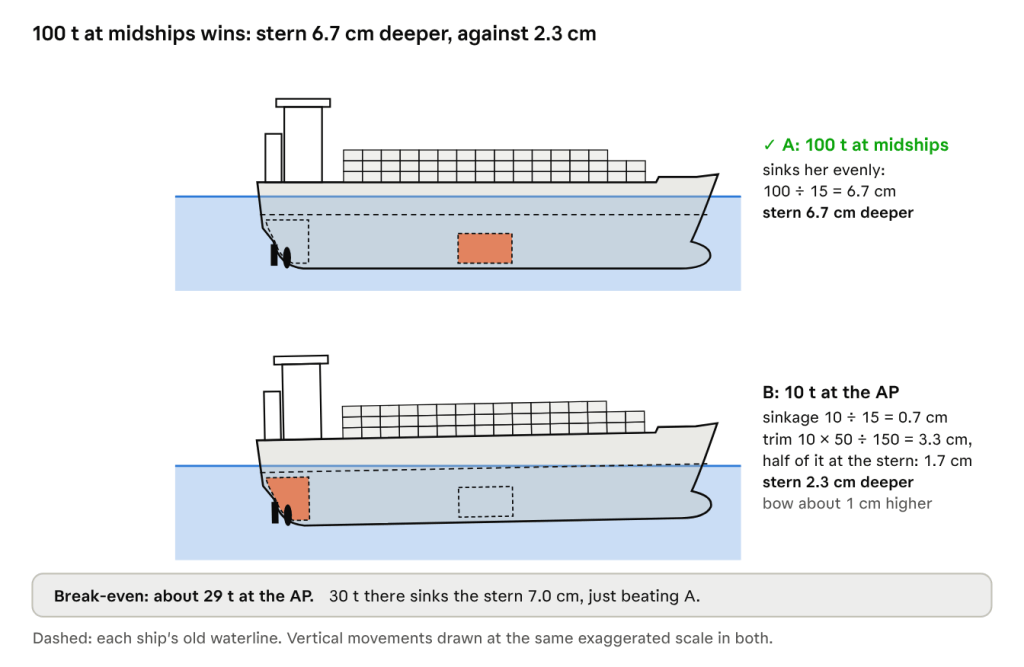
Puzzle 11 · Bury the propeller (design duel) In rough weather a 100 m ship’s propeller keeps lifting out of the water and racing. Her F is at midships, her TPC is 15 t/cm and her MCTC is 150 t·m/cm. The mate can pump either 100 t of ballast into a tank at midships, or 10 t into the aft peak tank at the aft perpendicular (AP), 50 m aft of F. Which pushes the stern, and the propeller, deeper?
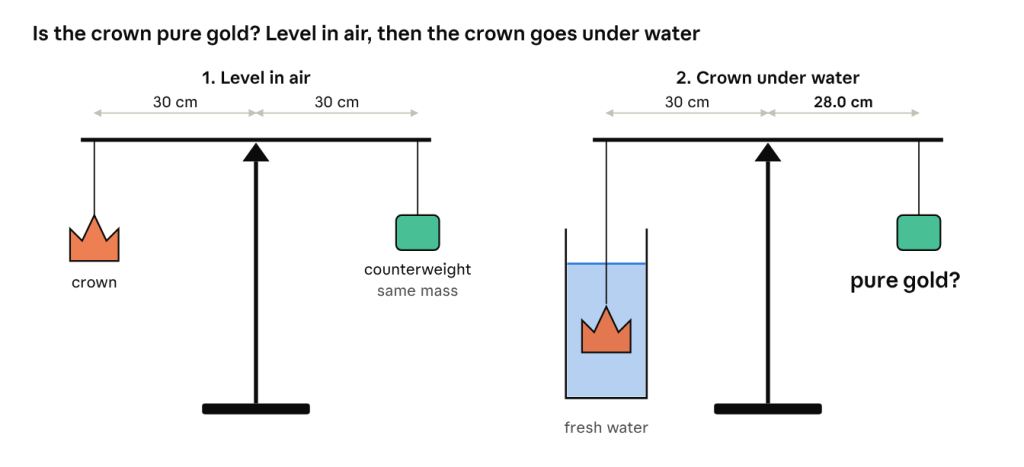
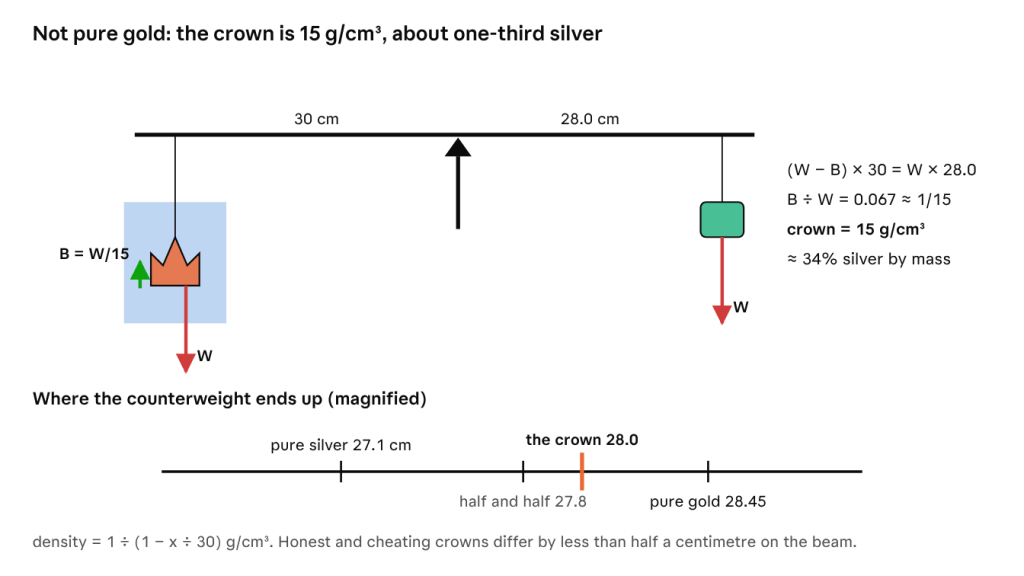
Puzzle 12 · Is the crown pure gold? (napkin estimate) A king suspects his goldsmith has mixed silver into a gold crown. The crown hangs from one arm of a balance, 30 cm from the pivot. A counterweight of the same mass hangs 30 cm out on the other arm, so the beam is level. Then the crown is lowered into fresh water until it is fully under, touching neither the sides nor the bottom. To level the beam again, the counterweight must slide in to 28.0 cm from the pivot. Gold is 19.3 g/cm³ and silver 10.5 g/cm³. Is the crown pure gold? If not, roughly how much of it is silver?
Answers
1 · Two steel balls: the hollow one floats. Both are the same steel and the same weight. What differs is the volume each one encloses. The solid ball takes up 124.4 kg ÷ 8 g/cm³ = 15,550 cm³. Even fully under water, it pushes aside just 15.55 kg of water, far short of its 124.4 kg, so it sinks. The hollow ball encloses about 523,600 cm³. Fully under, it would push aside 523.6 kg of water, more than four times its weight. It only needs to push aside 124.4 kg, so it floats with about 32 cm under water. Its average density is 124.4 kg ÷ 523,600 cm³ = 0.24 g/cm³, a quarter of water’s. The solid ball’s is that of steel, 8 g/cm³. The idea: same material, same weight; the enclosed volume decides.
2 · How thick before it sinks? About 2.2 cm. The ball hovers when its weight equals the water its outer volume can push aside: 523.6 kg. That much steel takes up 523.6 ÷ 8 = 65,450 cm³, exactly one-eighth of the ball’s outer volume. So the hollow inside must fill the other seven-eighths. The inner radius is then 50 × ∛(7/8) = 47.8 cm, leaving a wall 2.2 cm thick. At 5 mm the ball floats easily; at about 22 mm it hovers; any thicker and it sinks. The idea: a hollow body floats as long as its material takes up less of its outer volume than the ratio of the densities, here 1 part in 8.
3 · Two ice cubes: no, then yes, just. In fresh water, the floating ice already displaces exactly its own weight of fresh water. When it melts it becomes exactly that water, so the level stays put. In sea water, the ice displaces its weight of the denser sea water, which is a smaller volume. When it melts it becomes fresh water, which takes up about 2.5% more room than the sea water it was displacing. The glass overflows by a trickle. The idea: density, not just weight, decides volume.
4 · The 1,000-tonne bathtub: Yes. The barge doesn’t need 1,000 tonnes of water around it. It needs a hole in the water of 1,000 tonnes’ worth of volume. The thin layer of water in the gap carries the pressure all the way round, just as a full ocean would. Dry docks and ship lifts use this every day. The idea: displacement means water that would be there. It doesn’t have to be water that is there.
5 · Passengers per centimetre: about 5; a full load sinks her about 16 cm. Each hull’s waterplane is 20 × 1.5 × 0.6 = 18 m², so the two hulls together give 36 m². One centimetre of fresh water over that area weighs 36 × 0.01 × 1.0 = 0.36 tonnes. That is about 5 people at 75 kg. Seventy-five passengers weigh 5.6 tonnes, so Aditya sinks about 16 cm. Slender catamaran hulls have a small waterplane, so every passenger counts. The idea: TPC turns any load into a draft change in your head.
6 · River to sea: she rises, by about 12.5 cm. FWA = 10,000 ÷ (4 × 20) = 125 mm. This is why rules let a ship load slightly past her summer mark in a fresh-water port. She will come up to the right mark once she reaches the sea. The idea: same weight, denser water, less volume needed.
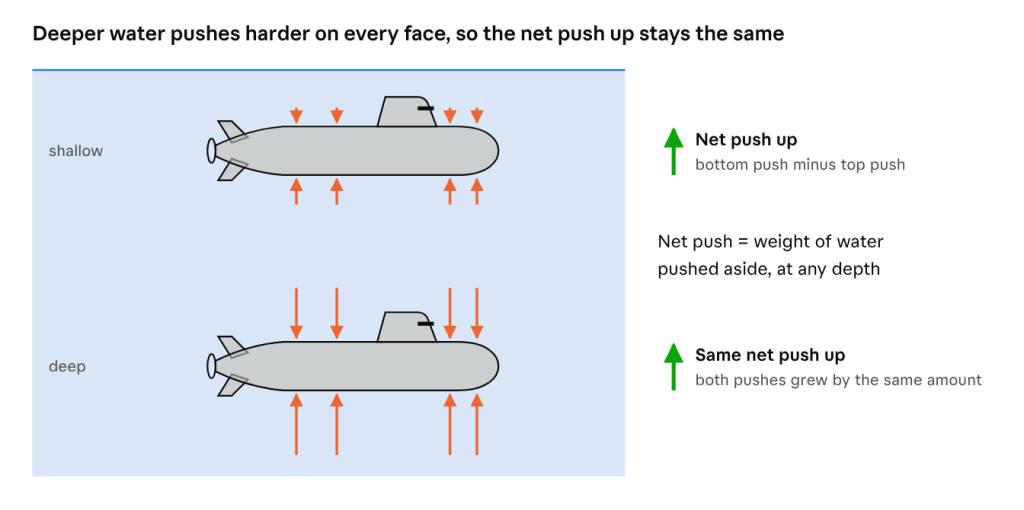
7 · Spot the error: depth doesn’t add lift. Pressure does rise with depth, but it rises on every face of the hull. The push from below grows, and so does the push from above. What is left over, the buoyancy, depends only on the volume of water pushed aside. That stays almost the same at any depth. If anything, a real hull squeezes slightly under pressure, loses a little volume and becomes heavier for its size. The idea: buoyancy is about volume, not depth.
8 · Design duel: a tie. Both waterplanes are 40 m². Each barge must displace 41 ÷ 1.025 = 40 m³, so each floats exactly 1.0 m deep. Shape changes many things, as later chapters will show, but not this. The idea: for a box, draft = volume needed ÷ waterplane area.
9 · Where does the container go? Directly above the centre of flotation, F. Not midships, and not above B. The ship pivots about F, so a weight there sinks both ends equally. Anywhere else, the weight has a lever arm about F and tips the ship. This works because 20 t barely changes the draft. For a large weight, F itself moves as she sinks; the weight then goes over the centre of the layer of hull between the old and new waterlines, roughly midway between the old F and the new F. The idea: added weight trims the ship unless it sits over F.
9b · A heavier load: about 2.5 m aft of midships. The extra buoyancy comes from the 40 cm layer of hull between the old and new waterlines. Its centre lies roughly halfway between the old F and the new F, about 2.5 m aft. Over the old F (2.0 m aft), the cargo sits ahead of the layer’s centre and she trims slightly by the head. Over the new F (3.0 m aft), she trims slightly by the stern. The idea: for no trim, added weight goes over the centre of the buoyancy it adds.
10 · Shifting cargo: 100 cm by the stern. The turning effect is 300 × 50 = 15,000 tonne-metres. Divided by 150, that is 100 cm. With F at midships, the stern goes down 50 cm and the bow comes up 50 cm. The mean draft doesn’t change, because nothing was added: the cargo only moved. MCTC barely changes over 1 m of trim on a 100 m ship; for trims of several metres, it and F must be recalculated as she trims. The idea: moving weight trims; adding weight sinks.
10b · Ten times the cargo: the method has run past its limit. The arithmetic is right. But 10 m of trim is 10% of her length, about 6°. At that angle the stern goes deep into much fuller sections, the bow, bulb and forefoot may lift clear of the water, and the deck edge aft may go under. The waterplane is no longer the one MCTC was worked out for, so MCTC and F both move a long way, and the real trim will differ noticeably from 10 m. The right approach is to work in small steps, recalculating MCTC and F each time, or to use trimmed hydrostatics. Long before that, the master would refuse to load her that way: with the bow high out of the water, the bridge unable to see the sea ahead and the deck edge aft close to the waves, she could not be handled safely. The idea: a constant MCTC is a small-trim tool; check the answer against the ship’s length before trusting it.
11 · Bury the propeller: the 100 t at midships, by about three times. At midships, over F, the 100 t only sinks her bodily: 100 ÷ 15 = 6.7 cm, at the stern as everywhere else. At the AP, the 10 t sinks her 10 ÷ 15 = 0.7 cm and trims her 10 × 50 ÷ 150 = 3.3 cm by the stern. With F at midships the stern takes half of that trim, 1.7 cm, so it goes down 0.7 + 1.7 = 2.3 cm, while the bow rises about 1 cm. The long lever makes each tonne at the AP worth about 3.5 tonnes at midships, but not ten. The two break even at about 29 t: put 30 t in the aft peak and the stern goes down 7.0 cm, just beating the 100 t at midships. The aft-peak option does have one virtue: it lifts the bow instead of sinking the whole ship, so it uses up less freeboard. The idea: a weight far aft works through both sinkage and trim, but a small weight on a long lever can still lose to a big weight on none.
12 · Is the crown pure gold? No: it is about one-third silver. Under water the crown loses the weight of the water it pushes aside; call that B. Taking moments about the pivot: (W − B) × 30 = W × 28.0, so B ÷ W = 1 − 28.0 ÷ 30 = 0.067, about 1/15. B ÷ W is the density of water divided by the density of the crown, so the crown is 15 g/cm³. Pure gold would have brought the counterweight in only to 28.45 cm; pure silver would have brought it to 27.1 cm. The crown sits between them, so it is a mix. Each gram of gold takes up 1/19.3 cm³ and each gram of silver 1/10.5 cm³; a crown averaging 1/15 cm³ per gram works out at about 34% silver by mass. The whole gap between an honest crown and a cheating one is under half a centimetre on the beam, so the balance had better be a good one. The idea: weighing in water measures volume, and weight divided by volume is density.
For the curious: the formulas behind it
Skip this box if you like. The puzzles can all be solved without it, though it makes some of them faster.
Displacement. Weight equals water density times the underwater volume. That volume is the box L × B × T, trimmed by the block coefficient C_B, which says how much of the box the hull actually fills.
\Delta = \rho \cdot \nabla = \rho \cdot L \cdot B \cdot T \cdot C_B
Example: a hull 40 m long, 10 m wide and 2 m deep in the water, with C_B = 0.6, displaces 40 × 10 × 2 × 0.6 = 480 m³. In sea water that weighs 480 × 1.025 = 492 tonnes. That is the ship’s weight.
Tonnes per centimetre. A_wp is the waterplane area in m².
TPC = \frac{A_{wp} \cdot \rho}{100}
Fresh water allowance. How much a ship sinks when she moves from sea water into fresh water, in millimetres, with Δ in tonnes and TPC in t/cm:
FWA = \frac{\Delta}{4 \cdot TPC}
The 4 is not magic. It comes from the 2.5% density difference between sea and fresh water.
Moment to change trim one centimetre. GM_L is the longitudinal metacentric height and L the ship’s length, both in metres. For most ships GM_L is roughly as large as L itself, so MCTC comes out close to Δ/100.
MCTC = \frac{\Delta \cdot GM_L}{100 \cdot L}
Change of trim. Moving a weight w (tonnes) a distance d (metres) along the ship changes the trim, in centimetres, by:
\delta t = \frac{w \cdot d}{MCTC}
Sharing the trim between bow and stern. The ship pivots about F. With l_A the distance from F to the aft draft mark, the stern draft changes by:
\delta T_A = \delta t \cdot \frac{l_A}{L}
The bow takes the rest, in the opposite direction. If F is at midships, each end moves by half the trim.
Contribute
If there are other interesting puzzles on flotation, do share to sandith@navalt.in

