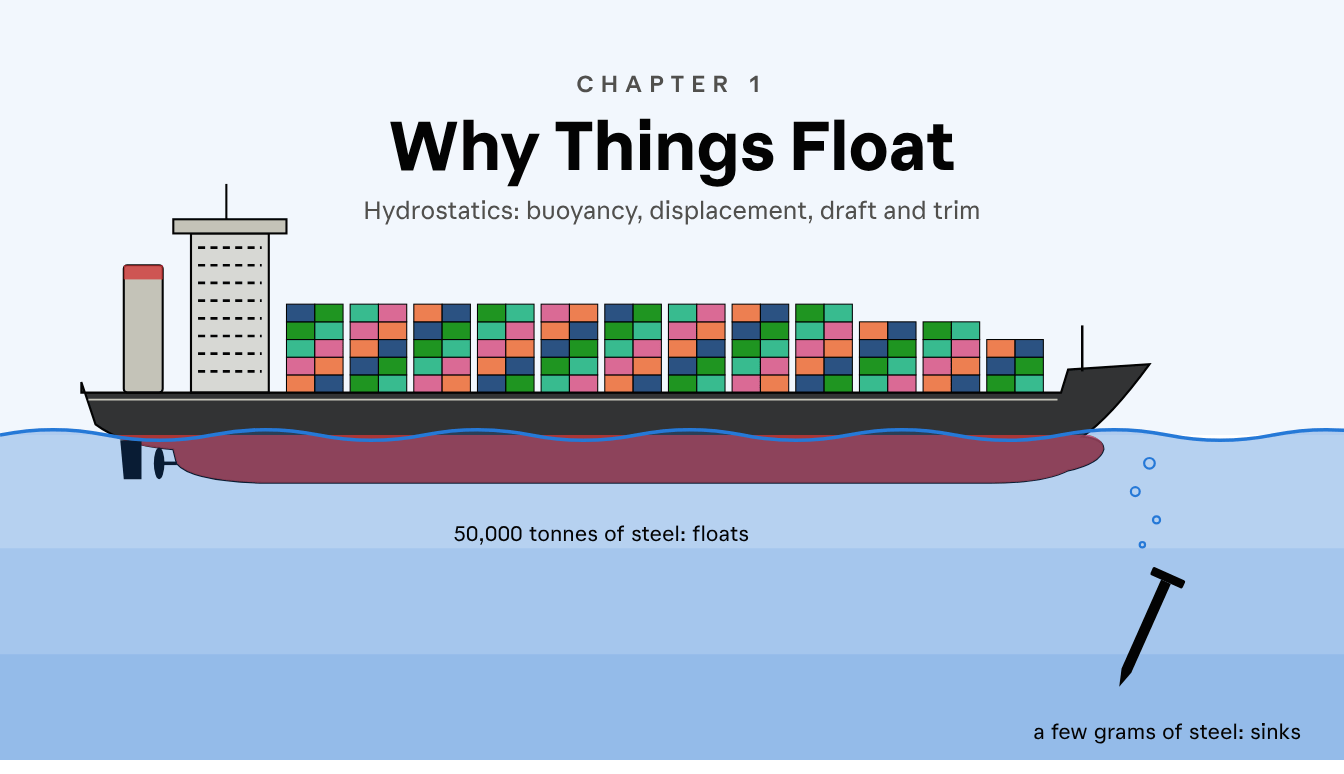

The nail and the ship
Drop a steel nail into the sea and it sinks at once. A container ship made of 50,000 tonnes of the same steel sails past and doesn’t sink.
So the steel isn’t what decides it. Something else is, and once you see it you will never look at a boat the same way. This chapter answers one question: why does anything float at all?
The big insight: a ship sinks until it has pushed aside its own weight
Put a boat on the water and it starts to sink. As it goes down it pushes water out of the way, and that water pushes back. The push grows as more of the hull goes under.
The boat stops sinking at one exact moment: when the water it has pushed aside weighs as much as the boat. Every floating thing obeys this law, from a coconut to an aircraft carrier.
A note on a famous story. Most schoolbooks credit this law to Archimedes and tell how he leapt from his bath shouting “Eureka!”. No record of that story survives from his lifetime, and it appears nowhere in his own writings. This book gives the law no hero. The water obeyed it long before anyone wrote it down.
Naval architects call that pushed-aside water the displacement. When someone says a ship “displaces 10,000 tonnes”, they are giving her weight. On a floating ship the two are the same number.
Now the nail makes sense. A cubic centimetre of steel weighs almost eight times as much as a cubic centimetre of sea water. The nail goes completely under before it has pushed aside enough water, so it keeps going down.
The ship uses the same steel in a different shape. It is a thin steel skin around a huge volume of air. Only a few metres of hull need to go under before the water pushed aside matches the whole ship’s weight.
Floating is not about what a thing is made of. It is about its average density: the total weight divided by the total volume it encloses. Below that of water, it floats. Above, it sinks.
Five things that follow
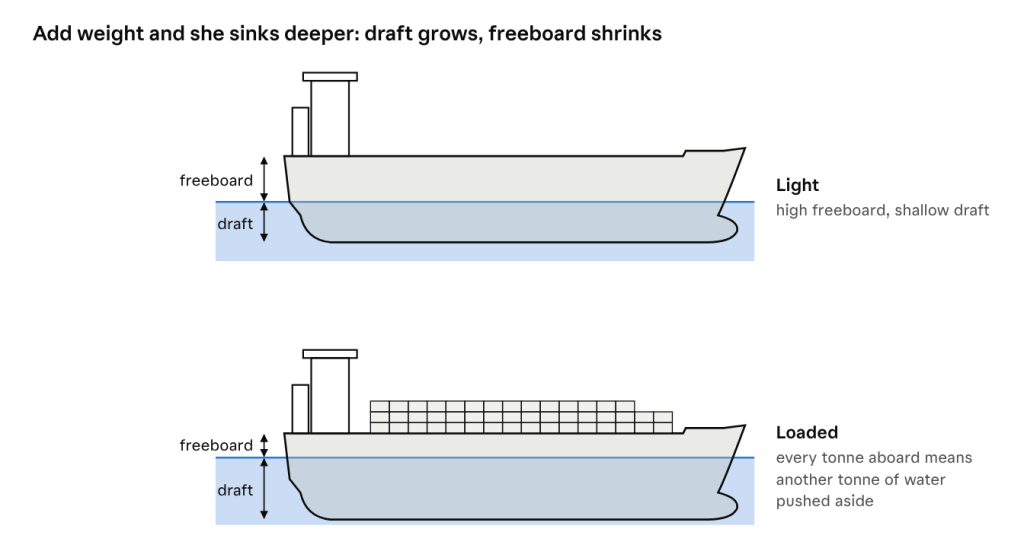
1. Add weight, and the ship sinks a little deeper. Every tonne loaded must be matched by another tonne of water pushed aside. The depth of hull below the waterline is the draft. The height of hull left above it is the freeboard. Load cargo and one grows while the other shrinks.
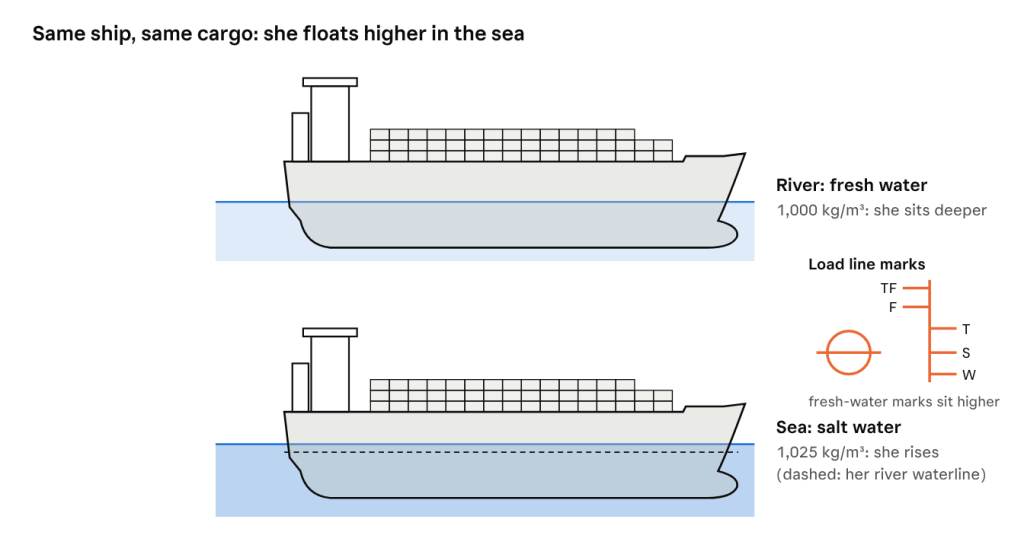
2. The same ship floats higher in the sea than in a river. Sea water carries dissolved salt, so a cubic metre of it weighs about 1,025 kg. Fresh water weighs 1,000 kg. In fresh water the ship must push aside about 2.5% more volume to match the same weight. A ship sailing from a river port out to sea rises in the water, though not one gram of cargo has moved. This is why a ship’s side carries the Plimsoll mark, a set of load lines with separate limits for fresh, tropical, summer and winter waters.
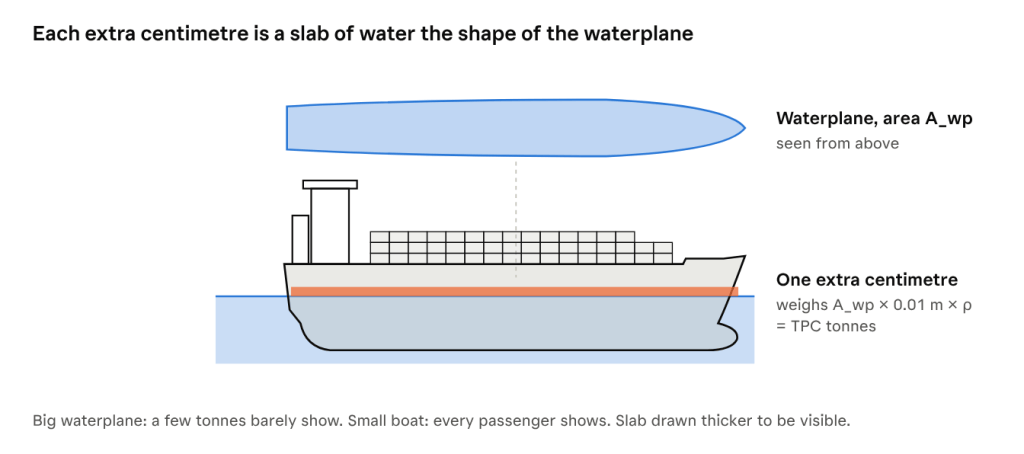
3. Each centimetre of sinking has a price in tonnes. Picture the ship slicing through the waterline like a cookie cutter. The shape it cuts is the waterplane. Sink one more centimetre and you push aside a thin slab of water the shape of that waterplane. Its weight is called TPC, tonnes per centimetre immersion. A ship with a big waterplane barely notices a few tonnes of cargo. A small boat notices every passenger.
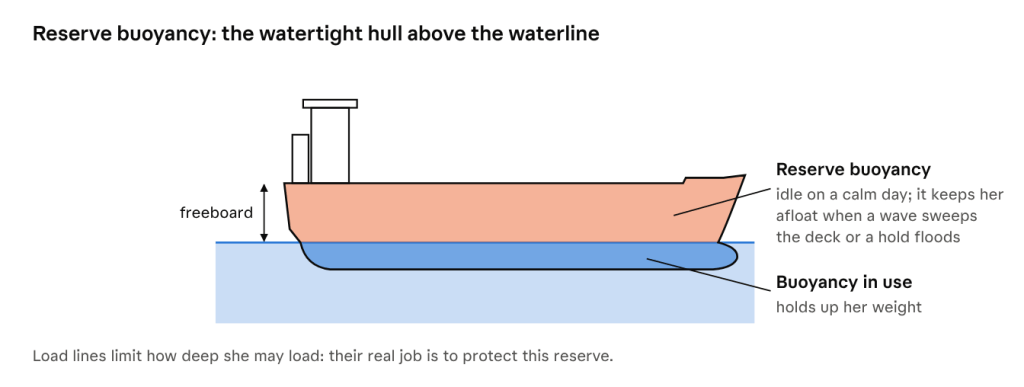
4. The hull above the water is the life insurance. The watertight volume between the waterline and the deck is reserve buoyancy. It does no work on a calm day. When a wave sweeps the deck or a compartment floods, it is the only thing between floating and sinking. That is why rules limit how deep a ship may be loaded. Their real job is to protect the freeboard.
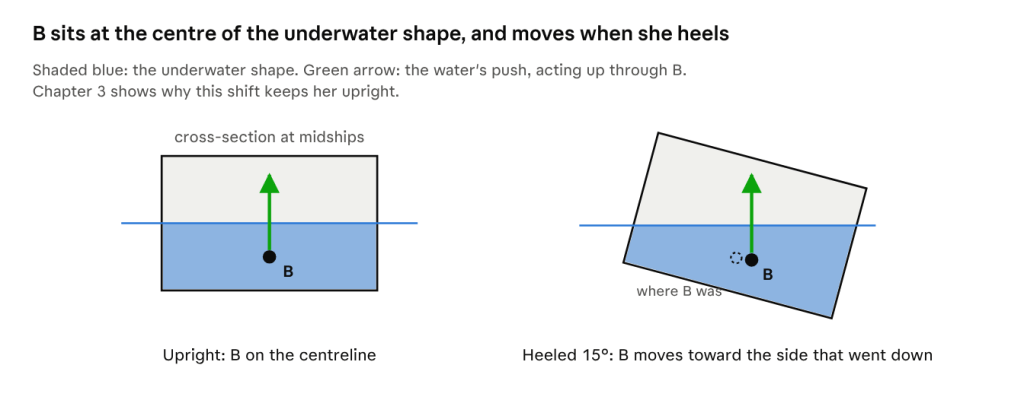
5. The water pushes up from one point. The buoyant force acts at the centre of the underwater volume. This point is the centre of buoyancy, B. When the ship heels, the underwater shape changes and B moves. That small shift is the whole secret of why ships stay upright, and it is Chapter 3.
A note from the electric-boat yard: on a diesel ship a few extra tonnes cost little. On a solar-electric boat every kilogram is carried on stored energy, every kilometre. Weight discipline starts here.
Trim: the seesaw you can’t see
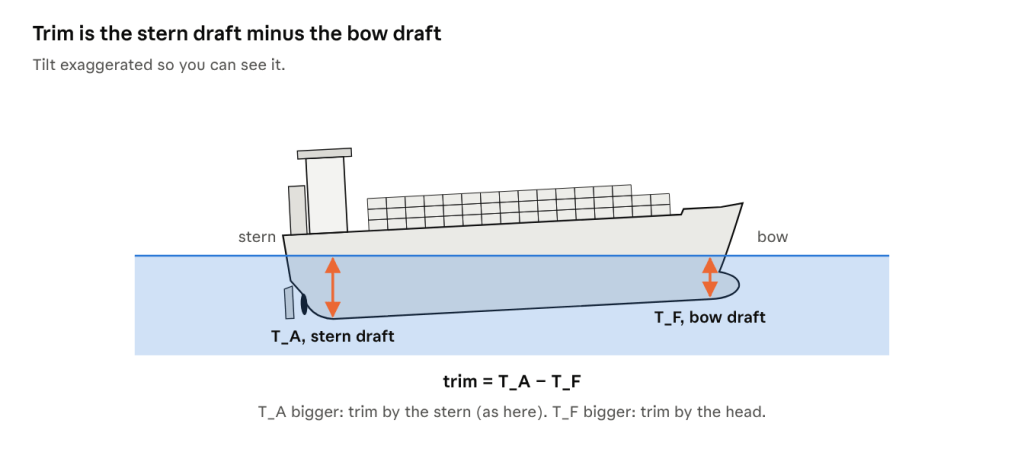
So far the ship has sunk straight down. Real ships also tilt end to end. The difference between the draft at the stern and the draft at the bow is the trim. Deeper at the stern means trim by the stern; deeper at the bow, trim by the head.
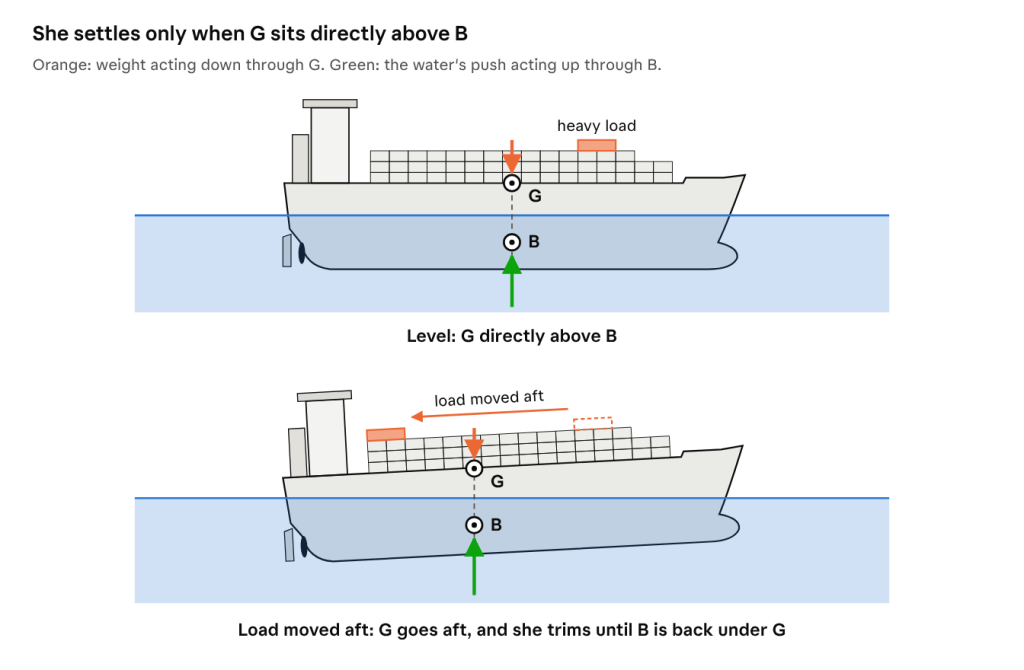
The rule is the same as before, applied lengthwise. The ship’s weight acts down through its centre of gravity, G. The water’s push acts up through the centre of buoyancy, B. The ship settles only when G and B sit on the same vertical line. Move a heavy load aft and G moves aft. The ship tilts until the underwater shape has shifted B aft to sit under G again.
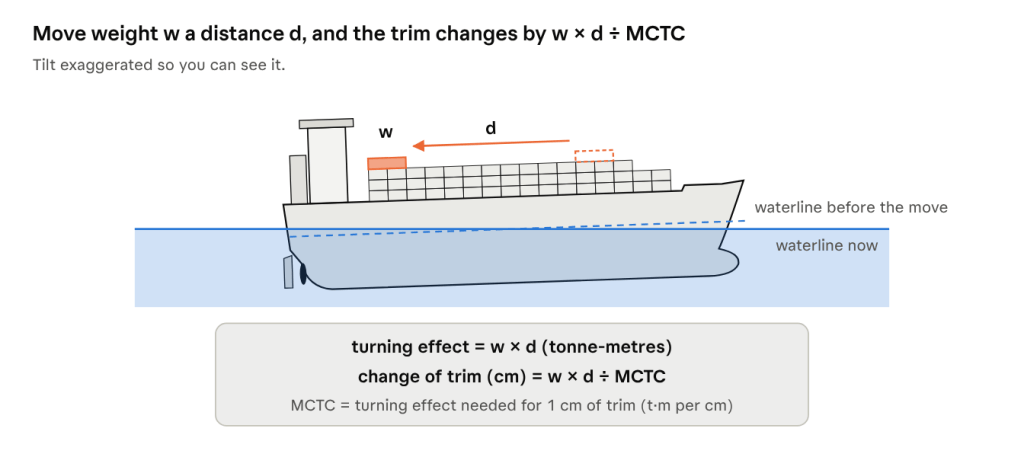
Every trim has a price, too. Moving weight along the ship creates a turning effect: the weight times the distance moved. Naval architects ask how much turning effect it takes to change the trim by one centimetre. That number is the MCTC, the moment to change trim one centimetre, in tonne-metres per centimetre. Divide the turning effect by MCTC and you have the change in trim.
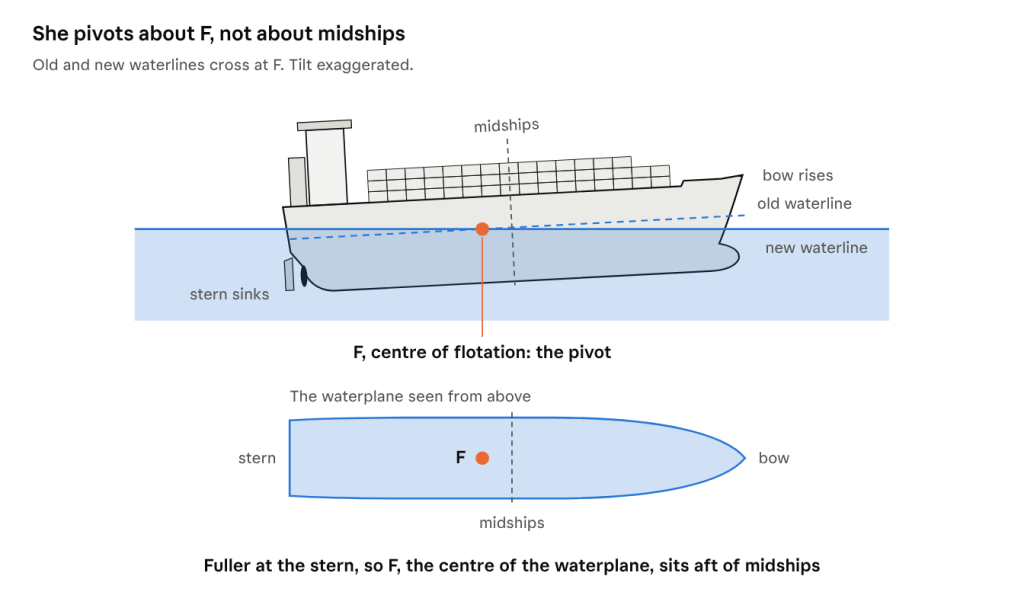
The ship doesn’t pivot about its middle. It pivots about the centre of the waterplane, called the centre of flotation, F. On most ships F sits a little aft of midships, because the stern is fuller at the waterline than the bow. Load a weight directly over F and the ship sinks evenly, with no trim at all. Load it anywhere else and it both sinks and trims.
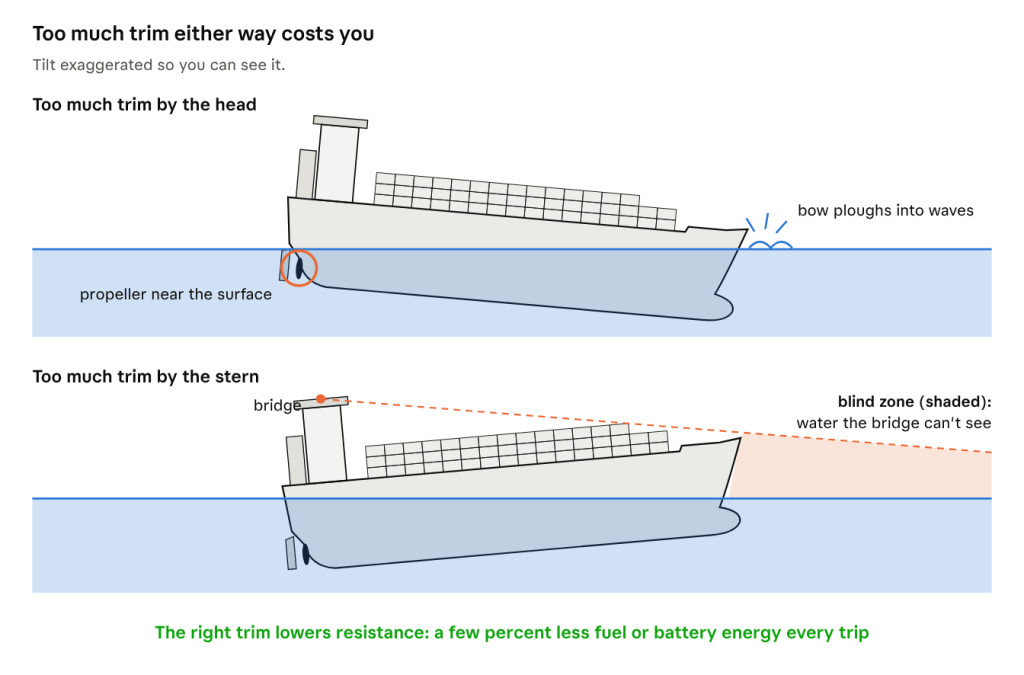
Trim matters more than it looks. Too much trim by the head and the propeller rises towards the surface and the bow ploughs into waves. Too much by the stern and the bridge loses sight of the water ahead. Trim also changes resistance, so the right trim can save a few percent of fuel or battery energy on every trip.
For the curious: the formulas behind it
Skip this box if you like. The puzzles can all be solved without it, though it makes some of them faster.
Displacement. Weight equals water density times the underwater volume. That volume is the box L × B × T, trimmed by the block coefficient C_B, which says how much of the box the hull actually fills.
Example: a hull 40 m long, 10 m wide and 2 m deep in the water, with C_B = 0.6, displaces 40 × 10 × 2 × 0.6 = 480 m³. In sea water that weighs 480 × 1.025 = 492 tonnes. That is the ship’s weight.
Tonnes per centimetre. A_wp is the waterplane area in m².
Fresh water allowance. How much a ship sinks when she moves from sea water into fresh water, in millimetres, with Δ in tonnes and TPC in t/cm:
The 4 is not magic. It comes from the 2.5% density difference between sea and fresh water.
Moment to change trim one centimetre. GM_L is the longitudinal metacentric height and L the ship’s length, both in metres. For most ships GM_L is roughly as large as L itself, so MCTC comes out close to Δ/100.
Change of trim. Moving a weight w (tonnes) a distance d (metres) along the ship changes the trim, in centimetres, by:
Sharing the trim between bow and stern. The ship pivots about F. With l_A the distance from F to the aft draft mark, the stern draft changes by:
The bow takes the rest, in the opposite direction. If F is at midships, each end moves by half the trim.
Enough of theory. Let’s get to the fun part in my next post.
Contribute
If there are interesting puzzles on flotation or other subjects in naval architecture, do share to sandith@navalt.in

