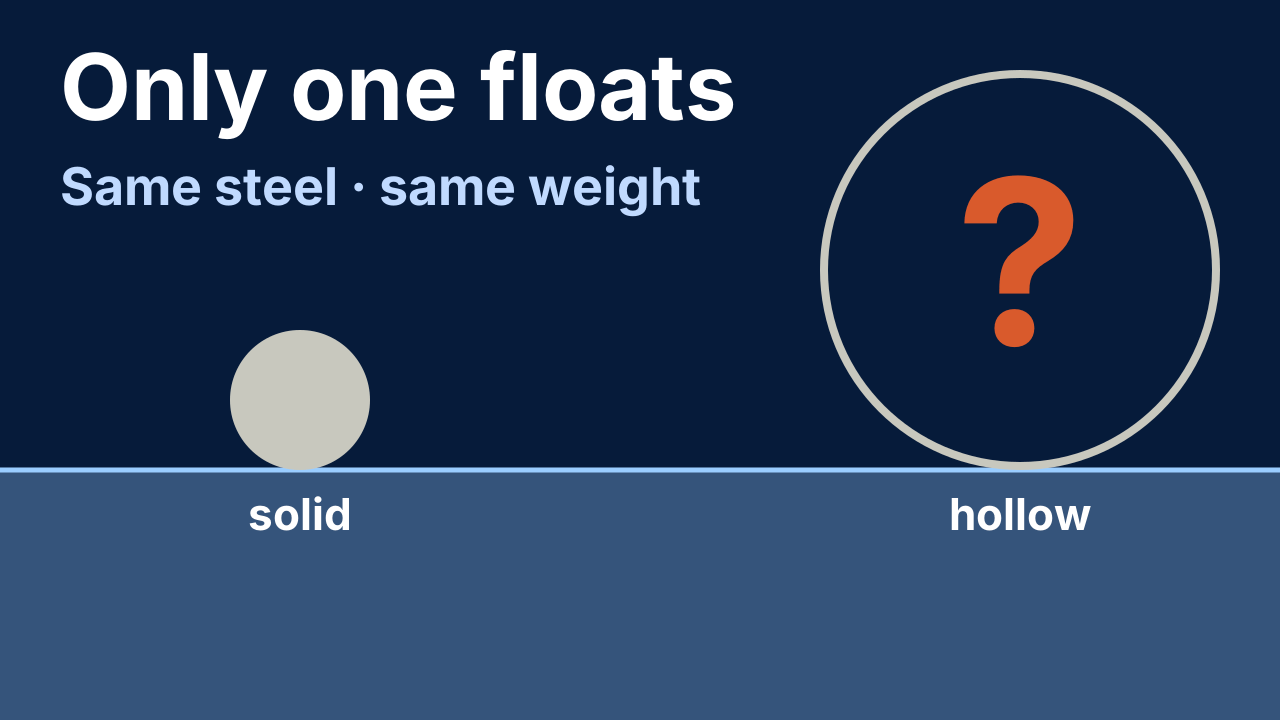

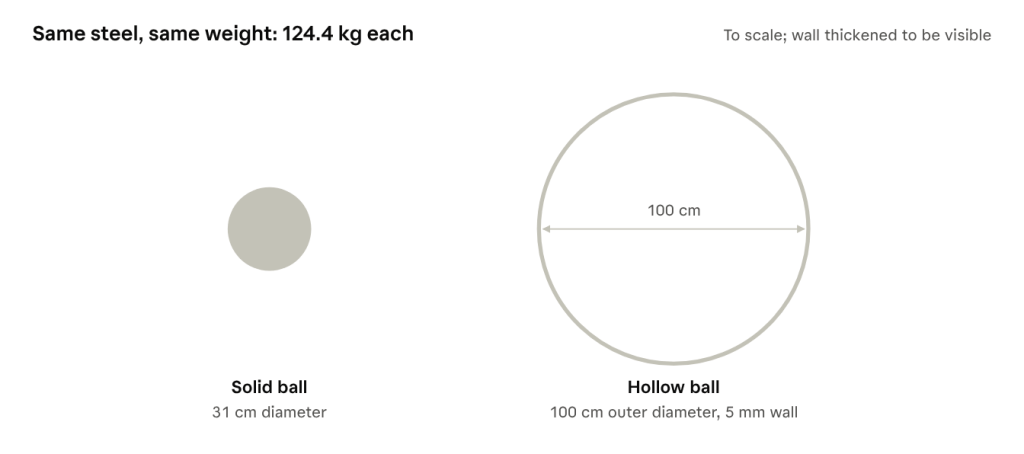
Two steel balls each weigh exactly 124.4 kg. The first is solid, 31 cm in diameter. The second is hollow: 100 cm in outer diameter, with a steel wall 5 mm thick. Both are dropped into fresh water. Take steel at 8 g/cm³ and fresh water at 1 g/cm³. Which one floats, and why?
Answer
1 · Two steel balls: the hollow one floats, the solid one sinks.
Water doesn’t know what a ball is made of. It feels only two things: how heavy the ball is, and how much room it takes up. Both balls are equally heavy. The hollow one takes up far more room, because its steel is spread thin around a big pocket of air.
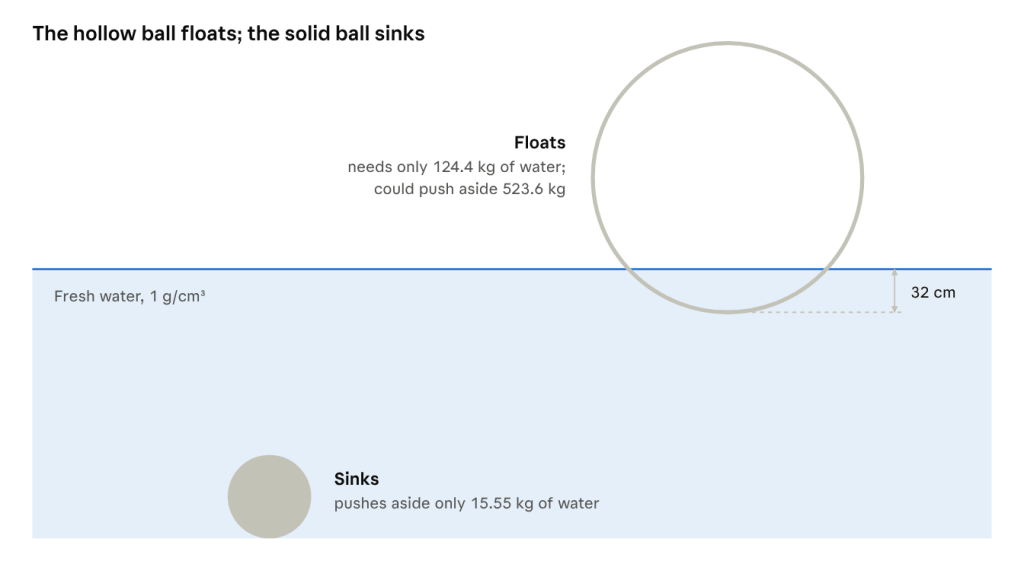
The solid ball takes up 124.4 kg ÷ 8 g/cm³ = 15,550 cm³. Fully under, it pushes aside only 15.55 kg of water, far short of its 124.4 kg, so it sinks. The hollow ball takes up π × 100³ ÷ 6 ≈ 523,600 cm³. Fully under, it would push aside 523.6 kg of water, more than four times its weight. It needs to push aside only 124.4 kg, so it floats with about 32 cm of its 100 cm under water.
The idea: same material, same weight; the enclosed volume decides.
General solution. Let m be the body’s mass and V_o the volume inside its outer surface, air and all. Fully under, it would push aside ρ_w V_o of water. It floats if that is more than its mass, that is, if its average density is below water’s:
For the solid ball V_o = m/ρ_s, so its average density is just that of steel, 8 g/cm³: it sinks. For the hollow ball it is 124.4 kg ÷ 523,600 cm³ = 0.24 g/cm³, a quarter of water’s: it floats. How deep? The part under water is a cap of the sphere, of depth h, and it must hold m/ρ_w of water:
With R = 50 cm and m/ρ_w = 124,400 cm³, h ≈ 32 cm.
A ship is the hollow ball. Her steel, on its own, would sink. Spread thin around air, it floats, and even fully loaded her average density, steel, cargo and air together, stays below that of water.
Contribute
If there are other interesting puzzles on flotation, do share to sandith@navalt.in

