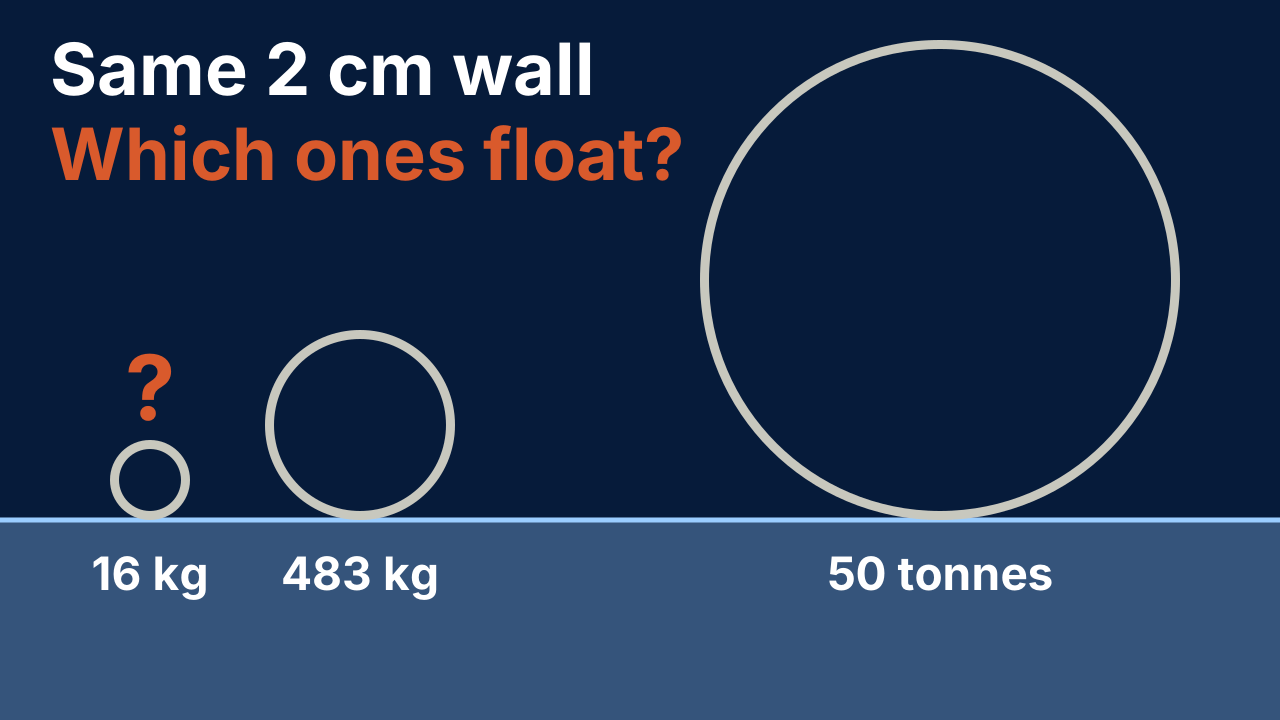

(napkin estimate)
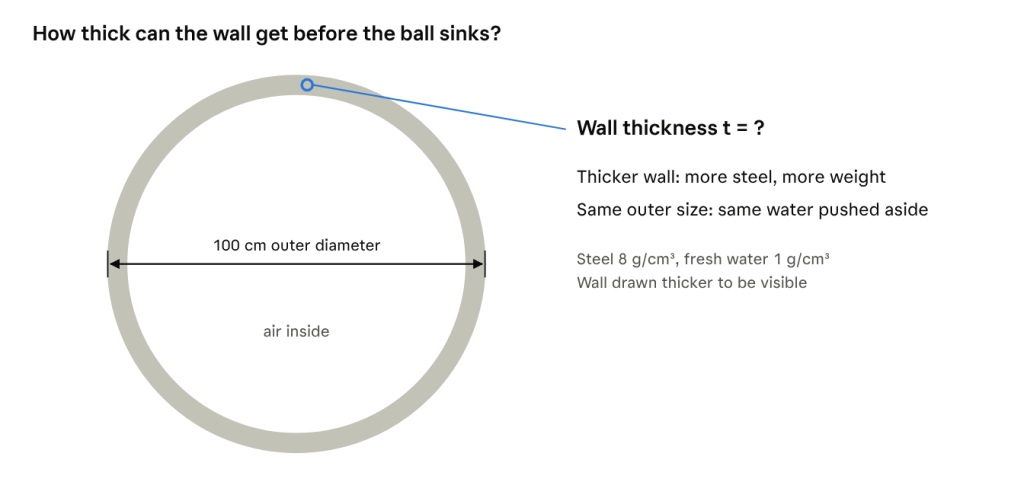
In Puzzle 2, the 1 m ball with its 2 cm wall floated, but low, with 83 cm of its 100 cm under water. Keep the same 1 m ball in the same fresh water, and make its wall thicker and thicker. At what wall thickness does it only just float, hovering fully under water? Any thicker, and it sinks.
Answer
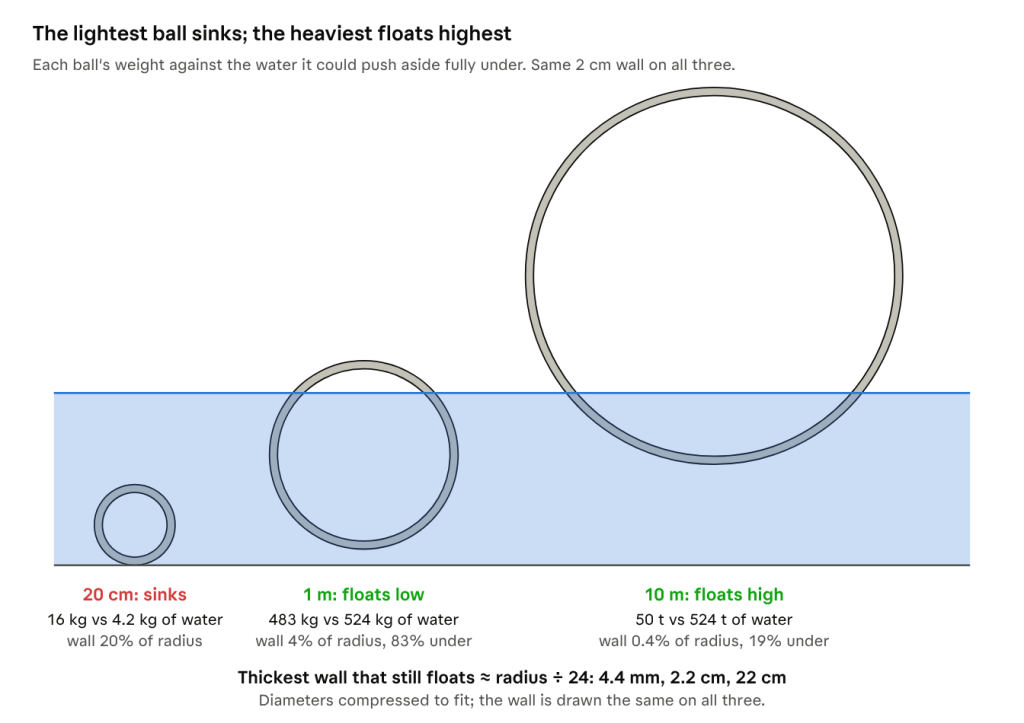
2· Bigger is easier: the 16 kg ball sinks, while the 483 kg and 50 t balls float.
Weight alone doesn’t decide it. What matters is weight compared with the water the ball can push aside. The wall is a skin: its weight grows with its area, which goes up with the size squared. The water the ball can push aside grows with its volume, which goes up with the size cubed. Make a ball ten times bigger and its skin weighs 100 times more, but it can push aside 1,000 times more water. So the biggest ball, though heaviest, has the most room to spare, and the smallest has the least.
Fully under, the 20 cm ball could push aside only 4.2 kg of water, far less than its 16 kg, so it sinks. The 1 m ball could push aside 524 kg, just more than its 483 kg, so it floats low, with 83 cm of its 100 cm under water. The 10 m ball could push aside 524 tonnes, more than ten times its 50 tonnes, so it floats high, with only 1.9 m of its 10 m under. Their average densities tell the same story: 3.9, 0.92 and 0.10 g/cm³.
The Idea: a wall’s thickness counts only relative to the size of the hull. Big hulls can afford thick skins; small ones can’t.
General solution. A ball of outer radius R and wall thickness t has an inner radius R − t, so its steel fills a share 1 − (1 − t/R)³ of its volume. It floats if that share is less than ρ_w/ρ_s:
For steel in fresh water, t_max ≈ R/24. The 2 cm wall is 20% of the small ball’s radius, well over the limit. It is 4% of the 1 m ball’s radius, just under. It is 0.4% of the big ball’s radius, far under. The thickest wall each could carry is 4.4 mm, 2.2 cm and 22 cm.
A 300 m ship carries plates 20 to 30 mm thick with ease. Put the same plates on a 10 m boat and she would sink. Plates can’t get proportionally thinner as boats get smaller, because of corrosion allowance, welding and the rules’ minimum thicknesses. That is why small boats are built in thin steel, aluminium or FRP.
Contribute
If there are other interesting puzzles on flotation, do share to sandith@navalt.in

