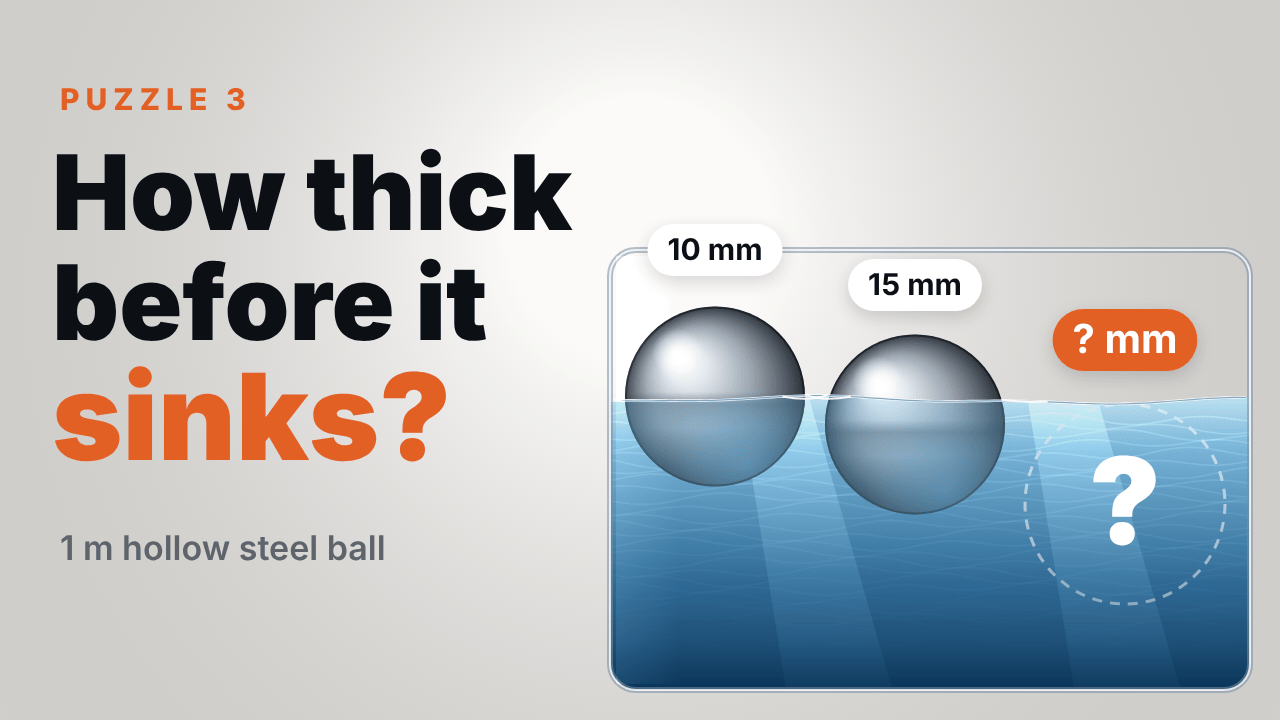

(napkin estimate)
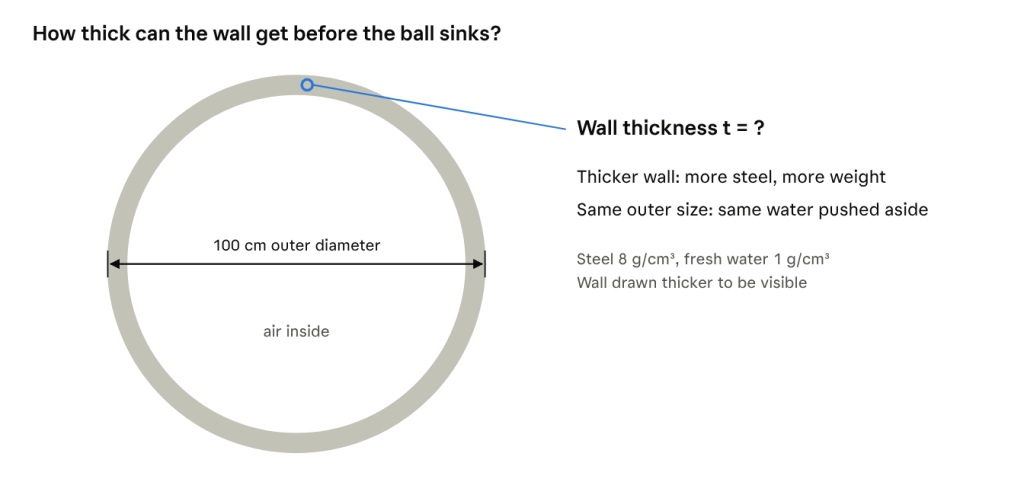
In Puzzle 2, the 1 m ball with its 2 cm wall floated, but low, with 83 cm of its 100 cm under water. Keep the same 1 m ball in the same fresh water, and make its wall thicker and thicker. At what wall thickness does it only just float, hovering fully under water? Any thicker, and it sinks.
Answer
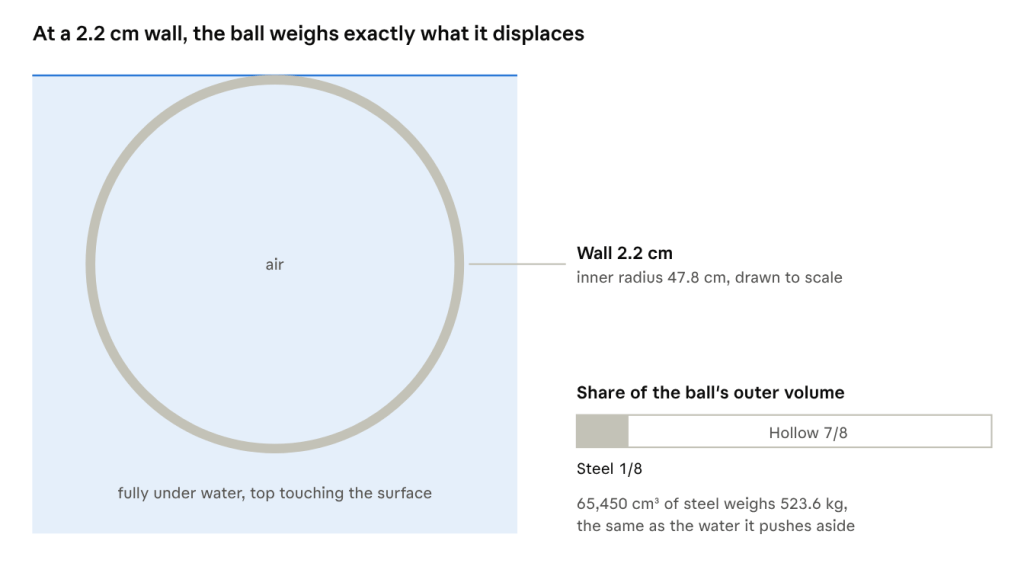
How thick before it sinks? About 2.2 cm. The ball hovers when its weight equals the water its outer volume can push aside: 523.6 kg. That much steel takes up 523.6 ÷ 8 = 65,450 cm³, exactly one-eighth of the ball’s outer volume. So the hollow inside must fill the other seven-eighths. The inner radius is then 50 × ∛(7/8) = 47.8 cm, leaving a wall 2.2 cm thick. At 5 mm the ball floats easily; at about 22 mm it hovers; any thicker and it sinks.
The idea: a hollow body floats as long as its material takes up less of its outer volume than the ratio of the densities, here 1 part in 8.
A quicker way to see it. Think of the wall as a thin skin. Its volume is its area times its thickness, 4πR²t. To hover, the steel must weigh as much as water filling the whole ball, (4/3)πR³. Steel is 8 times heavier than water, so the skin may take up only 1/8 of the ball’s volume: 4πR²t = (1/8)(4/3)πR³, which gives t = R/24, about 2.1 cm. The exact answer is a little more, because the inner surface is smaller than the outer one.
General solution. With outer radius R and inner radius r, the ball hovers when its mass equals the water its outer volume pushes aside:
Numbers. t = 50 × (1 − ∛0.875) = 2.2 cm. The thin-skin estimate, 50 ÷ 24 = 2.1 cm, is within 5%.
Contribute
If there are other interesting puzzles on flotation, do share to sandith@navalt.in

